
Free
$0Free plan available.
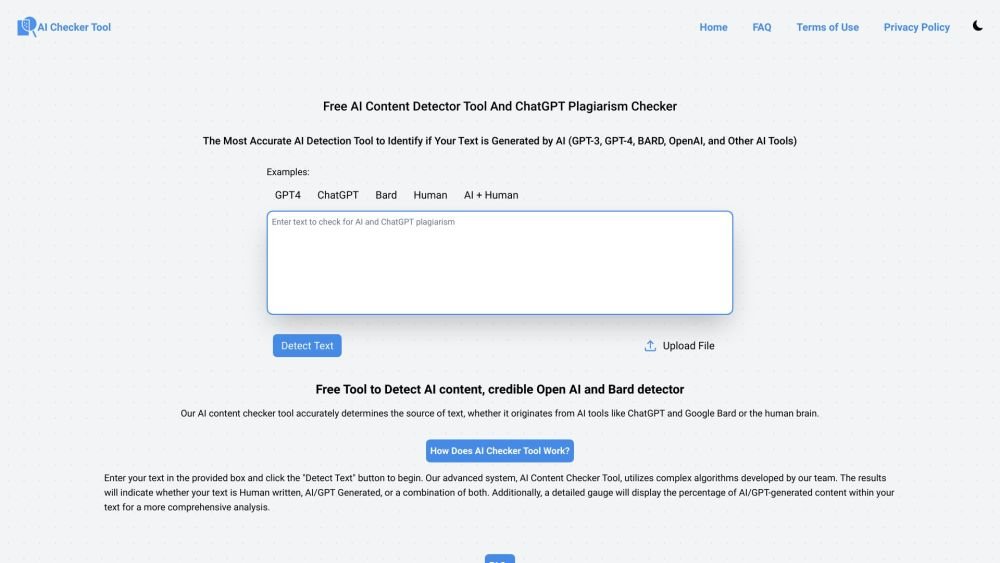
AI Checker Tool accurately identifies whether text was generated by AI models like ChatGPT and Google Bard or written by a human. It also includes a built-in plagiarism checker.
Input your text into the checker to determine if it was written by a human or generated by AI. The platform also provides functionality for plagiarism detection.
The tool accurately determines the origin of your text, identifying whether it was produced by AI models such as ChatGPT and Google Bard or written by a human.
Free plan available.
Use these comparison pages to understand the trade-offs between the models most relevant to AI Checker Tool.
Compare GPT 5.4 and GPT 5.4 Pro across pricing, context window, capabilities, benchmarks, and API access to choose the better fit for long-context workloads versus long-context workloads.
Compare GPT 5.5 and GPT 5.4 across pricing, context window, capabilities, benchmarks, and API access to choose the better fit for long-context workloads versus long-context workloads.
Compare GPT 5.5 and Claude 4.6 Opus across pricing, context window, capabilities, benchmarks, and API access to choose the better fit for long-context workloads versus long-context workloads.
Compare GPT 5.5 and Claude 4.6 Sonnet across pricing, context window, capabilities, benchmarks, and API access to choose the better fit for long-context workloads versus long-context workloads.

Similar AI tool in the AI Assistant category.
Similar AI tool in the AI Assistant category.
Similar AI tool in the AI Assistant category.
Similar AI tool in the AI Assistant category.
Similar AI tool in the Large Language Models (LLMs) category.
Similar AI tool in the AI Writing Assistants category.
Similar AI tool in the AI Marketing category.
Similar AI tool in the AI Assistant category.
Similar AI tool in the AI API category.
Similar AI tool in the AI Assistant category.
Similar AI tool in the AI Assistant category.
Similar AI tool in the AI Chatbot category.