
Free
$0Free plan available.
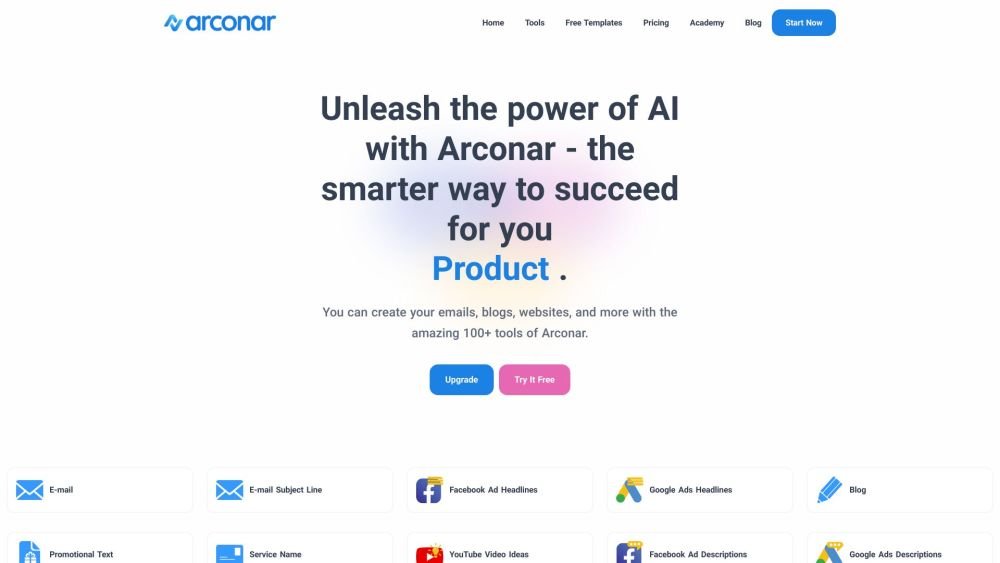
Arconar is an artificial intelligence tool marketplace that enables users to obtain accurate content results through various tools based on AI models. It offers over 100 tools for creating emails, blogs, websites, and more. Arconar supports multiple system languages and provides services in 30 different languages.
Create an account on the Arconar website, select your desired tool, choose your preferred language and word count, and generate your results. You may upgrade to a premium plan to access additional features.
Arconar is an artificial intelligence platform built with NLP technology. It provides over 100 tools for various applications, supports 30 languages, and includes a free trial offering up to 10,000 credits.
Arconar processes user inputs using natural language understanding and machine learning algorithms to generate human-like, accurate text outputs across multiple languages.
Arconar provides a diverse suite of tools suitable for various professional and personal needs, offering an efficient, cost-effective, and user-friendly experience that delivers high-quality results.
Register for an account on the Arconar website, select your preferred tool, set your language and word count requirements, and generate your content. You can upgrade to a premium subscription to unlock additional features.
Arconar provides both Basic and Premium plans. The Basic plan is free and includes 10,000 credits, while Premium plans offer expanded features and word counts, ranging from $19 to $89 per month.
Yes, Arconar prioritizes user data privacy and security, operating under a strict data privacy policy.
Users can access FAQs and video tutorials on the Arconar website or reach out to the support team via email or social media.
Yes, Arconar is designed to meet the requirements of both businesses and individuals across various industries, including marketing, email, blogging, and e-commerce.
Free plan available.
Use these comparison pages to understand the trade-offs between the models most relevant to Arconar.
Compare Gemini 1.0 Pro Deprecated and Gemini 2.0 Flash across pricing, context window, capabilities, benchmarks, and API access to choose the better fit for long-context workloads versus long-context workloads.
Compare Gemini 1.0 Pro Deprecated and Gemini 2.5 Flash across pricing, context window, capabilities, benchmarks, and API access to choose the better fit for long-context workloads versus long-context workloads.
Compare Gemini 2.0 Flash Lite and Gemini 2.0 Flash across pricing, context window, capabilities, benchmarks, and API access to choose the better fit for long-context workloads versus long-context workloads.
Compare Gemini 2.5 Flash and Gemini 2.0 Flash across pricing, context window, capabilities, benchmarks, and API access to choose the better fit for long-context workloads versus long-context workloads.

Similar AI tool in the AI Social Media Post Generator category.
Similar AI tool in the AI Writing Assistants category.
Similar AI tool in the AI Marketing category.
Similar AI tool in the AI Chatbot category.
Similar AI tool in the AI Assistant category.
Similar AI tool in the AI Assistant category.
Similar AI tool in the AI Writing Assistants category.
Similar AI tool in the AI Writing Assistants category.
Similar AI tool in the AI Assistant category.
Similar AI tool in the AI Chatbot category.
Similar AI tool in the AI Design Generator category.
Similar AI tool in the AI Marketing category.