
Free
$0Free plan available.
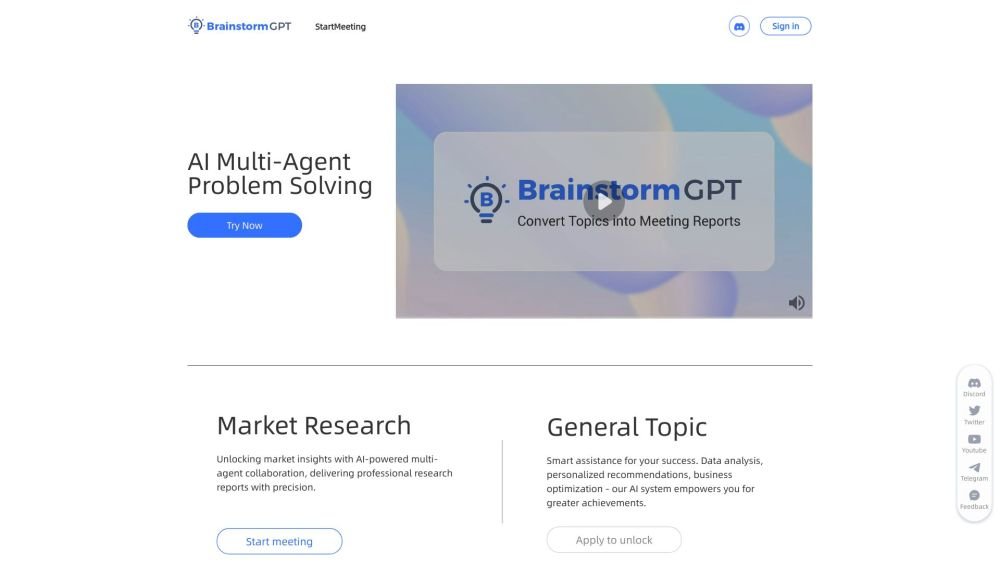
BrainstormGPT integrates multi-agent systems, LLMs, and automated search to streamline the conversion of topics into meeting reports. It enables users to define custom topics and assign specific roles to AI agents. These agents then engage in autonomous discussions, delivering a final report in 20 minutes—a process equivalent to 300 searches, 10 hours of discussion, and 100,000 text analyses.
Define your custom topic and assign user roles. BrainstormGPT's agents will then autonomously discuss the subject and generate a comprehensive report.
BrainstormGPT streamlines the conversion of topics into meeting reports by integrating multi-agent systems, LLMs, and automated search technology.
Free plan available.
Use these comparison pages to understand the trade-offs between the models most relevant to BrainstormGPT.
Compare GPT 5.4 and GPT 5.4 Pro across pricing, context window, capabilities, benchmarks, and API access to choose the better fit for long-context workloads versus long-context workloads.
Compare GPT 5.5 and GPT 5.4 across pricing, context window, capabilities, benchmarks, and API access to choose the better fit for long-context workloads versus long-context workloads.
Compare GPT 5.5 and Claude 4.6 Opus across pricing, context window, capabilities, benchmarks, and API access to choose the better fit for long-context workloads versus long-context workloads.
Compare GPT 5.5 and Claude 4.6 Sonnet across pricing, context window, capabilities, benchmarks, and API access to choose the better fit for long-context workloads versus long-context workloads.

Similar AI tool in the AI Assistant category.
Similar AI tool in the AI Assistant category.
Similar AI tool in the AI Assistant category.
Similar AI tool in the AI Productivity Tools category.
Similar AI tool in the AI Assistant category.
Similar AI tool in the AI Assistant category.
Similar AI tool in the AI Assistant category.
Similar AI tool in the AI Productivity Tools category.
Similar AI tool in the AI Assistant category.
Similar AI tool in the AI Chatbot category.
Similar AI tool in the AI Assistant category.
Similar AI tool in the AI Assistant category.