
Free
$0Free plan available.
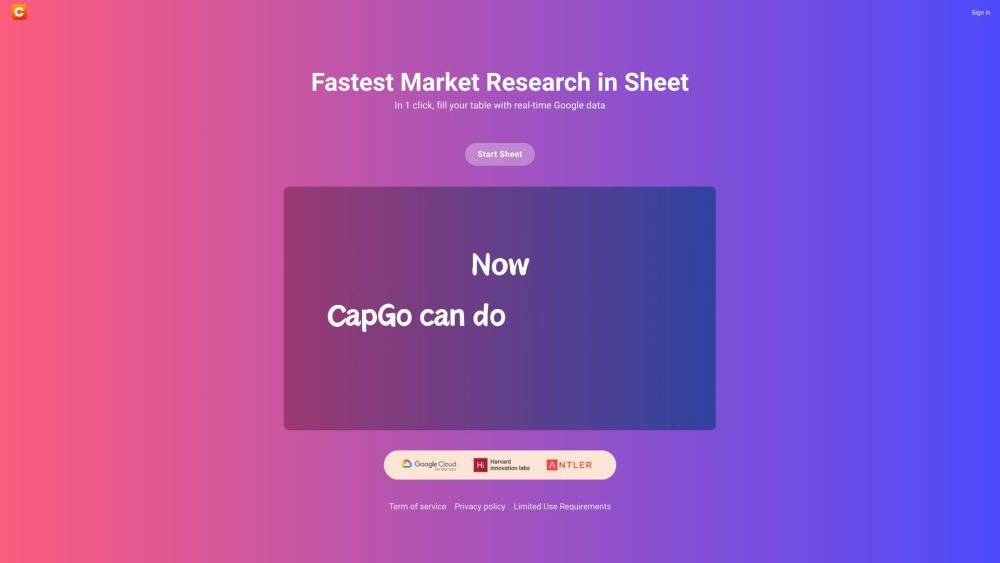
CapGo.AI is an AI-powered platform that automates data gathering and enrichment from the web and various databases. It allows users to define table headers and then automatically fill those tables with relevant data, streamlining market research, lead enrichment, programmatic SEO, and data cleaning processes. It aggregates web data and integrates with over 10 databases to provide comprehensive information.
Define your table headers, select your preferred data sources (including the web, LinkedIn, databases, or AI models), and CapGo.AI will automatically populate the table with the corresponding information.
CapGo.AI uses AI to populate spreadsheet cells based on your defined headers and selected data sources. Simply input your desired headers (e.g., 'Company Name,' 'Website,' 'Contact Person'), select a data source—such as web search, LinkedIn, databases, or AI models like GPT-4—and the platform will automatically fill in the data.
CapGo.AI supports multiple data sources, including web searches, LinkedIn profiles, databases, and AI models like GPT-4. You can view a full list of supported sources and integrations on the official CapGo.AI website.
Yes, CapGo.AI supports programmatic SEO workflows. You can use the platform to conduct keyword research and generate large volumes of SEO-optimized content directly within your spreadsheet.
CapGo.AI provides various pricing plans tailored to different usage levels. Please visit the CapGo.AI website for detailed pricing information to find the plan that best suits your needs.
Details regarding free trials or free tiers are available on the CapGo.AI website. Please visit the site to explore current options and get started.
Specific limitations concerning data collection and generation, such as data volume, rate limits, and AI model constraints, are outlined on the CapGo.AI website. Please refer to the website for a comprehensive overview of these limitations.
Free plan available.
Use these comparison pages to understand the trade-offs between the models most relevant to CapGo.AI.
Compare GPT 5.4 and GPT 5.4 Pro across pricing, context window, capabilities, benchmarks, and API access to choose the better fit for long-context workloads versus long-context workloads.
Compare GPT 5.5 and GPT 5.4 across pricing, context window, capabilities, benchmarks, and API access to choose the better fit for long-context workloads versus long-context workloads.
Compare GPT 5.5 and Claude 4.6 Opus across pricing, context window, capabilities, benchmarks, and API access to choose the better fit for long-context workloads versus long-context workloads.
Compare GPT 5.5 and Claude 4.6 Sonnet across pricing, context window, capabilities, benchmarks, and API access to choose the better fit for long-context workloads versus long-context workloads.

Similar AI tool in the AI Image Generator category.
Similar AI tool in the AI Assistant category.
Similar AI tool in the AI Assistant category.
Similar AI tool in the AI Marketing category.
Similar AI tool in the AI Productivity Tools category.
Similar AI tool in the AI Assistant category.
Similar AI tool in the AI Assistant category.
Similar AI tool in the AI Chatbot category.
Similar AI tool in the AI Writing Assistants category.
Similar AI tool in the AI Assistant category.
Similar AI tool in the AI Chatbot category.
Similar AI tool in the AI Chatbot category.