
Free
$0Free plan available.
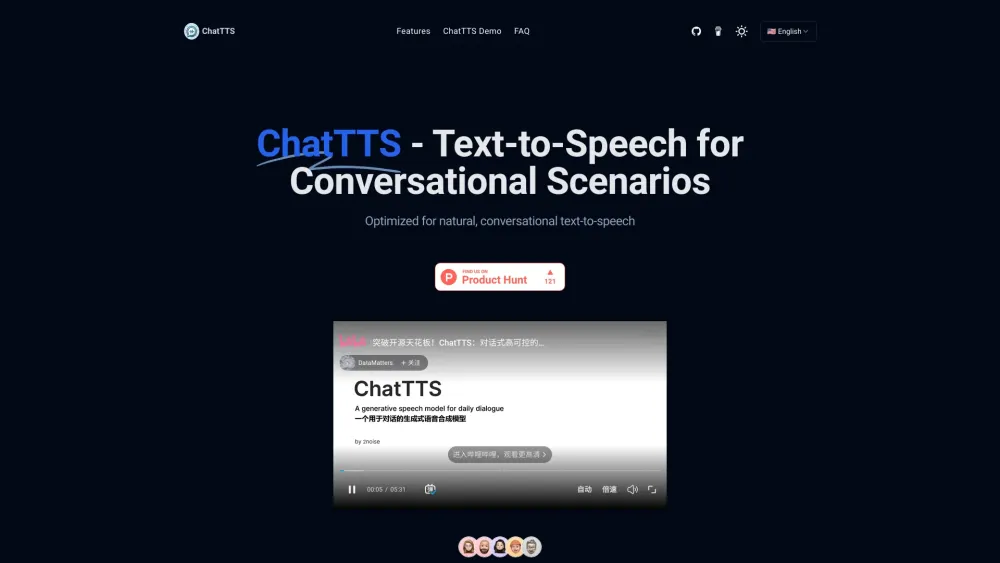
ChatTTS is a voice generation model designed for conversational scenarios. It is ideal for applications such as dialogue tasks for large language model assistants, as well as conversational audio and video introductions. The model supports both Chinese and English, demonstrating high quality and naturalness in speech synthesis. This level of performance is achieved through training on approximately 100,000 hours of Chinese and English data. The project team plans to open-source a basic model trained with 40,000 hours of data, which will aid the academic and developer communities in further research and development.
To use ChatTTS, download the code from GitHub, install the necessary dependencies (torch and ChatTTS), import the required libraries, initialize the ChatTTS model, prepare your text, generate speech using the infer method, and play the resulting audio using the Audio class from IPython.display.
Developers can integrate ChatTTS into their applications by using the provided API and SDKs. The process involves initializing the ChatTTS model, loading the pre-trained weights, and calling the text-to-speech functions to generate audio. Detailed documentation and examples are available to guide the integration.
ChatTTS is suitable for various applications, including conversational tasks for LLM assistants, dialogue generation, video introductions, educational content synthesis, and any service requiring text-to-speech functionality.
ChatTTS is trained on approximately 100,000 hours of Chinese and English data to ensure high-quality, natural speech. The team also plans to release an open-source base model trained on 40,000 hours of data to facilitate academic and developer research.
Yes, ChatTTS supports both Chinese and English. By training on a large dataset in these languages, it provides high-quality speech synthesis suitable for multilingual environments.
ChatTTS is specifically optimized for dialogue scenarios, making it highly effective for conversational applications. Its support for Chinese and English, combined with training on a vast dataset and the planned release of an open-source base model, distinguishes it in the field.
ChatTTS is trained on approximately 100,000 hours of Chinese and English data. This diverse dataset includes a wide variety of spoken content, enabling the model to generate natural and high-quality speech across different synthesis tasks.
Yes, the project team plans to release an open-source version of ChatTTS trained on 40,000 hours of data, allowing developers and researchers to explore and expand upon the model's capabilities.
ChatTTS achieves natural speech by training on a diverse dataset of approximately 100,000 hours of Chinese and English audio. This allows the model to capture speech patterns, intonations, and nuances, while advanced machine learning techniques further optimize it for conversational contexts.
Yes, ChatTTS can be customized. Developers can fine-tune the model using their own datasets to meet specific use cases or to create unique voice profiles, providing flexibility for different applications.
ChatTTS is designed for compatibility across various platforms, including web applications, mobile apps, desktop software, and embedded systems. The provided SDKs and APIs support multiple programming languages to facilitate implementation.
While powerful, ChatTTS has limitations. Synthesized speech quality may vary based on input text complexity and length. Additionally, performance depends on available computational resources, as real-time high-quality generation may require significant processing power.
Users can provide feedback or report issues through the project's support channels, such as email, support portals, or community forums. Providing detailed logs or examples helps the team address concerns. Users may also contribute to the project's GitHub repository by submitting issues or pull requests.
Free plan available.
Use these comparison pages to understand the trade-offs between the models most relevant to ChatTTS.
Compare Gemini 1.0 Pro Deprecated and Gemini 2.0 Flash across pricing, context window, capabilities, benchmarks, and API access to choose the better fit for long-context workloads versus long-context workloads.
Compare Gemini 1.0 Pro Deprecated and Gemini 2.5 Flash across pricing, context window, capabilities, benchmarks, and API access to choose the better fit for long-context workloads versus long-context workloads.
Compare Gemini 2.0 Flash Lite and Gemini 2.0 Flash across pricing, context window, capabilities, benchmarks, and API access to choose the better fit for long-context workloads versus long-context workloads.
Compare Gemini 2.5 Flash and Gemini 2.0 Flash across pricing, context window, capabilities, benchmarks, and API access to choose the better fit for long-context workloads versus long-context workloads.

Similar AI tool in the AI Assistant category.
Similar AI tool in the AI Assistant category.
Similar AI tool in the AI Assistant category.
Similar AI tool in the AI Productivity Tools category.
Similar AI tool in the AI Writing Assistants category.
Similar AI tool in the AI Writing Assistants category.
Similar AI tool in the AI Writing Assistants category.
Similar AI tool in the AI Assistant category.
Similar AI tool in the AI Chatbot category.
Similar AI tool in the AI Chatbot category.
Similar AI tool in the AI Chatbot category.
Similar AI tool in the AI Assistant category.