
Free
$0Free plan available.
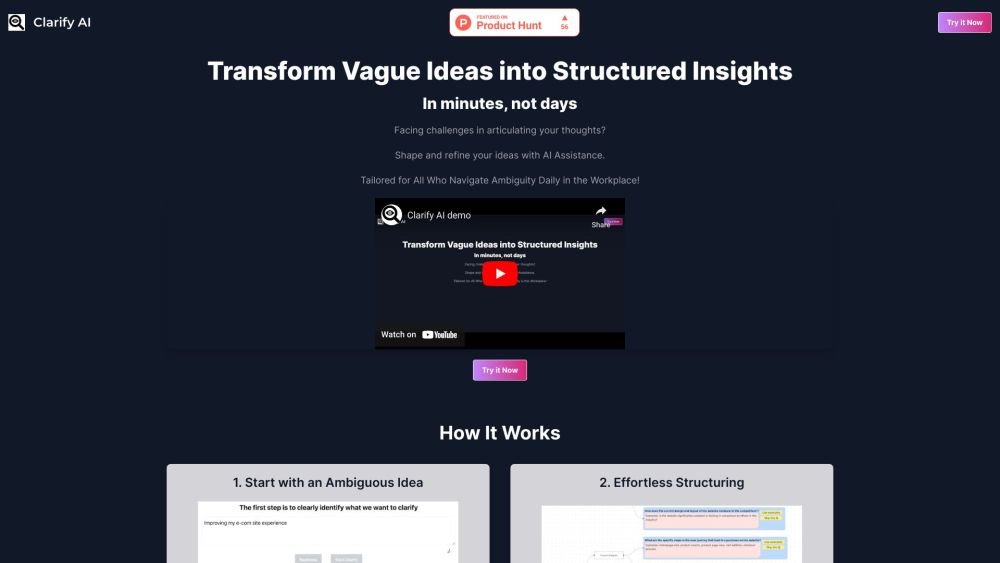
Clarify AI is an AI-powered tool designed to help users transform vague ideas into structured insights. It assists in organizing thoughts, clarifying complex problems, and facilitating efficient idea structuring. It is aimed at consultants, managers, and knowledge workers to improve productivity and decision-making.
Begin by inputting a vague idea or problem, and Clarify AI will refine it. The tool automatically organizes your thoughts into an issue tree. You can then supplement this with your own insights or use Clarify AI to conduct targeted research. Finally, generate actionable notebooks to communicate your ideas.
Yes. Many SaaS platforms function as wrappers around services like AWS. The more important questions are: What value does this tool provide, and how much time does it save compared to using ChatGPT directly?
We prioritize your data privacy and do not misuse your information. Our focus is on experimenting with efficient ways to structure complex problems. We guarantee that no external parties will access your responses without your explicit permission. Your input data is used only for product improvement or debugging and will not be used as training data.
Thinking clearly and comprehensively is a difficult skill, especially regarding unfamiliar topics, and it often requires significant cognitive effort. As intelligence becomes a commodity, we believe it is worth developing better tools to assist with thinking when such intelligence is readily available.
You certainly can. If you need to search or ask straightforward questions where you already know what you want, you should use Google, ChatGPT, or Claude. We created this tool because we were impressed by AI capabilities but frustrated by their limitations: 1. Providing context to a chatbot can be tedious and difficult to organize. 2. Language models can be narrow-minded and get stuck in one direction when addressing complex problems. Without solving these issues, using standard chatbots can be difficult, and achieving a productivity boost often requires significant effort in prompt engineering and context management.
Free plan available.
Use these comparison pages to understand the trade-offs between the models most relevant to Clarify AI.
Compare GPT 5.4 and GPT 5.4 Pro across pricing, context window, capabilities, benchmarks, and API access to choose the better fit for long-context workloads versus long-context workloads.
Compare GPT 5.5 and GPT 5.4 across pricing, context window, capabilities, benchmarks, and API access to choose the better fit for long-context workloads versus long-context workloads.
Compare GPT 5.5 and Claude 4.6 Opus across pricing, context window, capabilities, benchmarks, and API access to choose the better fit for long-context workloads versus long-context workloads.
Compare GPT 5.5 and Claude 4.6 Sonnet across pricing, context window, capabilities, benchmarks, and API access to choose the better fit for long-context workloads versus long-context workloads.

Similar AI tool in the AI Assistant category.
Similar AI tool in the AI Assistant category.
Similar AI tool in the AI Productivity Tools category.
Similar AI tool in the AI Assistant category.
Similar AI tool in the AI Assistant category.
Similar AI tool in the AI Assistant category.
Similar AI tool in the AI Chatbot category.
Similar AI tool in the AI Chatbot category.
Similar AI tool in the AI Productivity Tools category.
Similar AI tool in the AI Assistant category.
Similar AI tool in the AI Assistant category.
Similar AI tool in the AI Assistant category.