
Free
$0Free plan available.
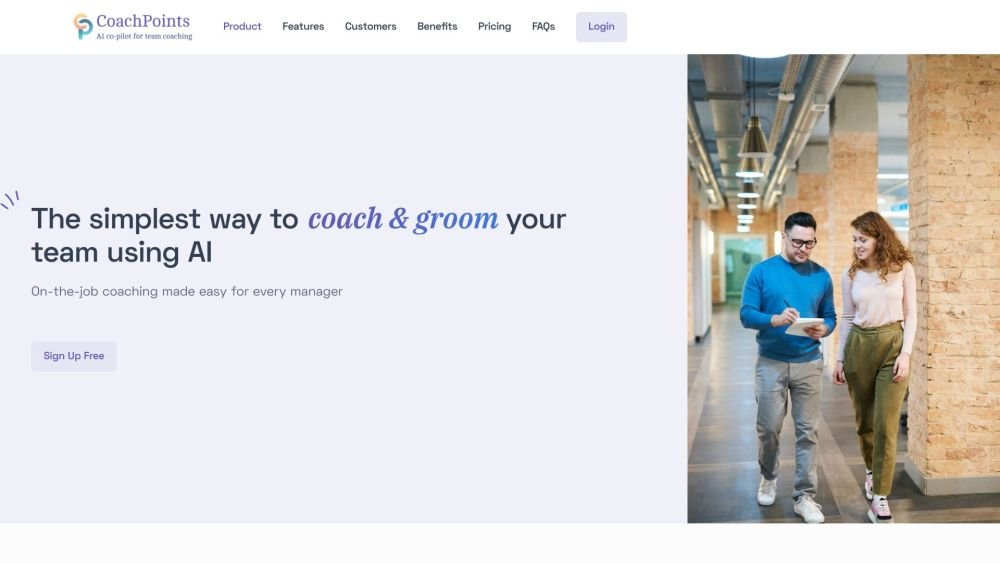
CoachPoints is an AI-driven platform designed to enhance team coaching. It provides managers with tools to log feedback and coaching inputs, and generate AI-guided coaching plans personalized for each teammate. It simplifies on-the-job coaching for people managers, helping them create custom coaching plans based on specific inputs.
Managers can add teammates, define roles, and track performance trajectories on the dashboard. They can then record coaching inputs to generate personalized, AI-powered coaching plans that include practical mini-exercises for each team member.
CoachPoints is designed for individuals in various people management roles, including Business Managers, Product Managers, and Engineering Managers.
CoachPoints provides a platform to record coaching inputs, generate guidance and development plans based on specific teammate feedback, and store these notes for future reference.
The coaching plan generation feature uses AI technology (GPT-4) to convert manager feedback into detailed guidance and structured coaching plans. These plans can be adjusted and edited at the manager's discretion.
Coaching plans are typically generated for each teammate every 1-2 weeks, aligning with the 1-on-1 meeting schedule between managers and their direct reports.
CoachPoints is designed to work across desktop and mobile devices. The web application is accessible via any standard browser on both desktop and mobile platforms.
Our product is built with advanced security features and adheres to strict data protection regulations to ensure your information remains safe and private.
We offer three plans: Starter (Free), CoachPoints Plus ($5/month), and Enterprise (Custom Pricing).
Yes, you can cancel your subscription at any time through your 'My Account' section. Once cancelled, your subscription remains active until the end of your current billing cycle.
Free plan available.
Use these comparison pages to understand the trade-offs between the models most relevant to CoachPoints.
Compare GPT 5.4 and GPT 5.4 Pro across pricing, context window, capabilities, benchmarks, and API access to choose the better fit for long-context workloads versus long-context workloads.
Compare GPT 5.5 and GPT 5.4 across pricing, context window, capabilities, benchmarks, and API access to choose the better fit for long-context workloads versus long-context workloads.
Compare GPT 5.5 and Claude 4.6 Opus across pricing, context window, capabilities, benchmarks, and API access to choose the better fit for long-context workloads versus long-context workloads.
Compare GPT 5.5 and Claude 4.6 Sonnet across pricing, context window, capabilities, benchmarks, and API access to choose the better fit for long-context workloads versus long-context workloads.

Similar AI tool in the AI Assistant category.
Similar AI tool in the AI Assistant category.
Similar AI tool in the AI Assistant category.
Similar AI tool in the AI Productivity Tools category.
Similar AI tool in the AI Assistant category.
Similar AI tool in the AI Assistant category.
Similar AI tool in the AI Assistant category.
Similar AI tool in the AI Productivity Tools category.
Similar AI tool in the AI Assistant category.
Similar AI tool in the AI Chatbot category.
Similar AI tool in the AI Assistant category.
Similar AI tool in the AI Assistant category.