
Free
$0Free plan available.
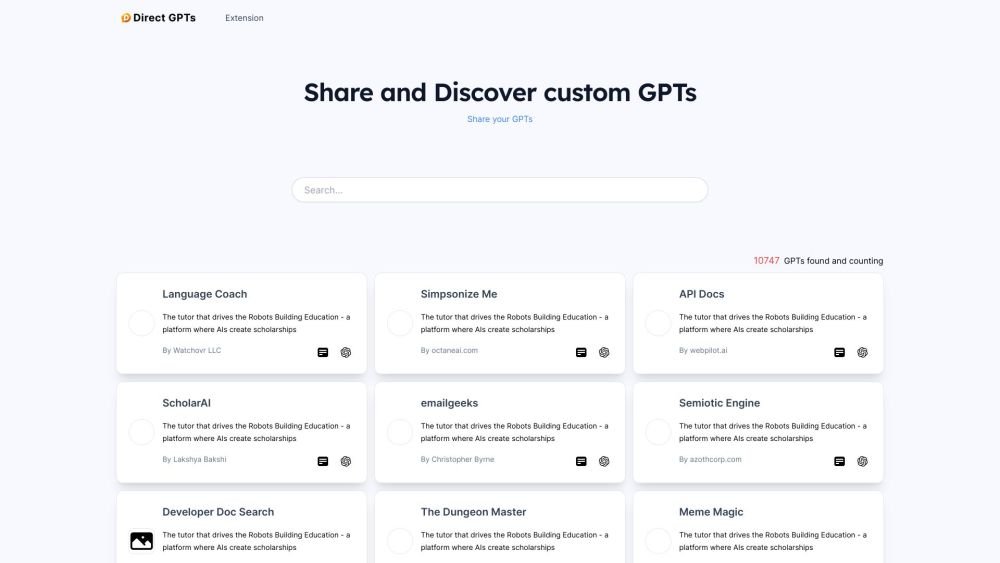
DirectGPTs provides a simple platform for exploring and discussing GPT prompts. Users can find and choose from a diverse range of GPTs in the GPT Selection, aiming to enhance productivity and creativity.
Users can browse the GPT Selection to find and select from a diverse range of available GPTs.
DirectGPTs is a platform for exploring and discussing GPT prompts, where users can discover and select from a diverse range of GPTs.
You can browse and select from a diverse range of GPTs within the GPT Selection to support your productivity and creative tasks.
Free plan available.
Use these comparison pages to understand the trade-offs between the models most relevant to DirectGPTs.
Compare GPT 5.4 and GPT 5.4 Pro across pricing, context window, capabilities, benchmarks, and API access to choose the better fit for long-context workloads versus long-context workloads.
Compare GPT 5.5 and GPT 5.4 across pricing, context window, capabilities, benchmarks, and API access to choose the better fit for long-context workloads versus long-context workloads.
Compare GPT 5.5 and Claude 4.6 Opus across pricing, context window, capabilities, benchmarks, and API access to choose the better fit for long-context workloads versus long-context workloads.
Compare GPT 5.5 and Claude 4.6 Sonnet across pricing, context window, capabilities, benchmarks, and API access to choose the better fit for long-context workloads versus long-context workloads.

Similar AI tool in the AI Assistant category.
Similar AI tool in the AI Assistant category.
Similar AI tool in the AI Assistant category.
Similar AI tool in the AI Productivity Tools category.
Similar AI tool in the AI Assistant category.
Similar AI tool in the AI Assistant category.
Similar AI tool in the AI Chatbot category.
Similar AI tool in the AI Chatbot category.
Similar AI tool in the AI Assistant category.
Similar AI tool in the AI Chatbot category.
Similar AI tool in the AI Assistant category.
Similar AI tool in the AI Assistant category.