
Free
$0Free plan available.
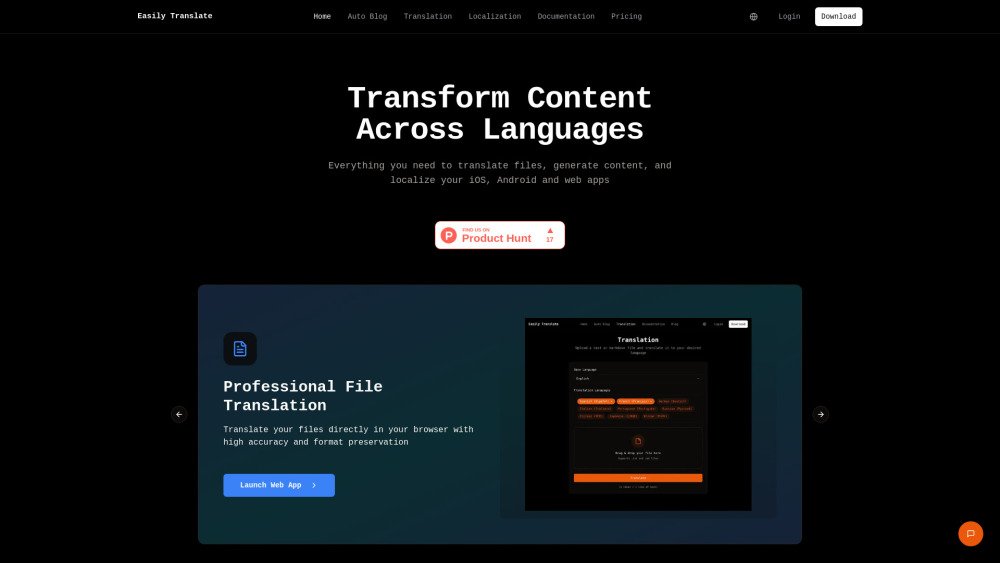
Easily Translate is a professional translation platform for iOS, Android, and web applications. Powered by GPT-4, it offers context-aware translations, AI blog generation, and app localization. It supports file translation, multilingual blog creation, and native app localization for iOS, Android, and web apps. The platform provides features such as format preservation, real-time translation, and automatic syncing.
Users can translate files directly within their browser, generate and translate blog content into multiple languages using AI, and localize iOS, Android, and web applications using the native macOS app.
The web platform supports the translation of TXT and MD files, along with AI-powered blog generation in multiple languages. These features are accessible directly through your browser without requiring any installation.
The macOS app is designed for iOS app localization, with support for String Catalogs and resource files. It also provides file translation capabilities and quick access via the menu bar to streamline your workflow.
Both platforms support over 95 languages using neural machine translation, ensuring high-quality results across all supported file formats and content types.
The web platform supports TXT and MD files, while the macOS app supports iOS String Catalogs, resource files, TXT, and MD files. Both platforms maintain original formatting and context throughout the translation process.
Data security is a priority across both platforms. All translations are processed using enterprise-grade encryption, and your content is never stored without your permission.
Yes, the platforms are designed to work together seamlessly. You can utilize the web platform for content translation and blog generation, while using the macOS app for iOS app localization.
You can manage your subscription settings, billing details, and view your order history through our secure customer portal at Lemon Squeezy.
Free plan available.
Use these comparison pages to understand the trade-offs between the models most relevant to Easily Translate.
Compare GPT 5.4 and GPT 5.4 Pro across pricing, context window, capabilities, benchmarks, and API access to choose the better fit for long-context workloads versus long-context workloads.
Compare GPT 5.5 and GPT 5.4 across pricing, context window, capabilities, benchmarks, and API access to choose the better fit for long-context workloads versus long-context workloads.
Compare GPT 5.5 and Claude 4.6 Opus across pricing, context window, capabilities, benchmarks, and API access to choose the better fit for long-context workloads versus long-context workloads.
Compare GPT 5.5 and Claude 4.6 Sonnet across pricing, context window, capabilities, benchmarks, and API access to choose the better fit for long-context workloads versus long-context workloads.