
Free
$0Free plan available.
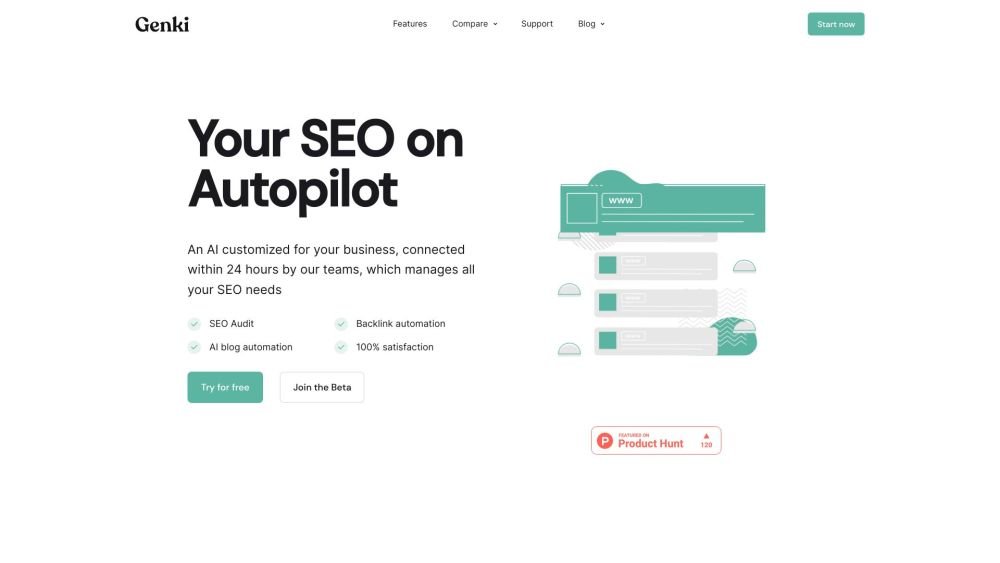
Genki AI SEO is an AI-powered platform designed to automate and manage all aspects of a business's SEO needs. It offers features such as blog post creation, backlink generation, and SEO strategy customization. The platform aims to provide a fast, automated, and expert SEO solution, delivering monthly reports to track progress and fine-tune strategies.
To use Genki AI SEO, integrate the platform with your website builder to allow the AI to audit your SEO requirements. Once the audit is complete, the AI is fine-tuned to begin generating blog posts and identifying backlink opportunities. You will receive monthly reports to monitor progress and adjust the AI's strategy as needed.
Genki integrates seamlessly with major website builders, including WordPress, Wix, Shopify, Squarespace, Webflow, Framer.io, and Bubble.io. You will need to provide your website API key; if you require assistance, we can guide you via email or schedule a video call.
Our AI-powered blog writing tool is designed to understand your industry and brand voice. It produces unique, relevant content tailored to your audience to help establish industry authority and drive engagement.
Our software utilizes advanced algorithms to identify high-ranking, reputable domains relevant to your industry. We prioritize quality over quantity to build a strong backlink profile.
We prioritize customer satisfaction and the effectiveness of our solution. If you are not seeing expected results, our team will analyze your SEO performance to identify challenges and make necessary adjustments. If you remain unsatisfied after these adjustments, we offer a satisfaction guarantee policy.
Our software analyzes various SEO metrics, including traffic, keyword rankings, and backlink quality. These insights are used to continuously refine our strategy and improve your SEO performance, providing measurable results to track your success.
Free plan available.
Use these comparison pages to understand the trade-offs between the models most relevant to Genki AI SEO.
Compare Gemini 1.0 Pro Deprecated and Gemini 2.0 Flash across pricing, context window, capabilities, benchmarks, and API access to choose the better fit for long-context workloads versus long-context workloads.
Compare Gemini 1.0 Pro Deprecated and Gemini 2.5 Flash across pricing, context window, capabilities, benchmarks, and API access to choose the better fit for long-context workloads versus long-context workloads.
Compare Gemini 2.0 Flash Lite and Gemini 2.0 Flash across pricing, context window, capabilities, benchmarks, and API access to choose the better fit for long-context workloads versus long-context workloads.
Compare Gemini 2.5 Flash and Gemini 2.0 Flash across pricing, context window, capabilities, benchmarks, and API access to choose the better fit for long-context workloads versus long-context workloads.

Similar AI tool in the AI Image Generator category.
Similar AI tool in the AI Writing Assistants category.
Similar AI tool in the AI Image Generator category.
Similar AI tool in the No-Code&Low-Code category.
Similar AI tool in the AI Marketing category.
Similar AI tool in the AI Assistant category.
Similar AI tool in the AI Chatbot category.
Similar AI tool in the AI Writing Assistants category.
Similar AI tool in the AI Assistant category.
Similar AI tool in the AI Chatbot category.
Similar AI tool in the AI Chatbot category.
Similar AI tool in the AI Writing Assistants category.