
Free
$0Free plan available.
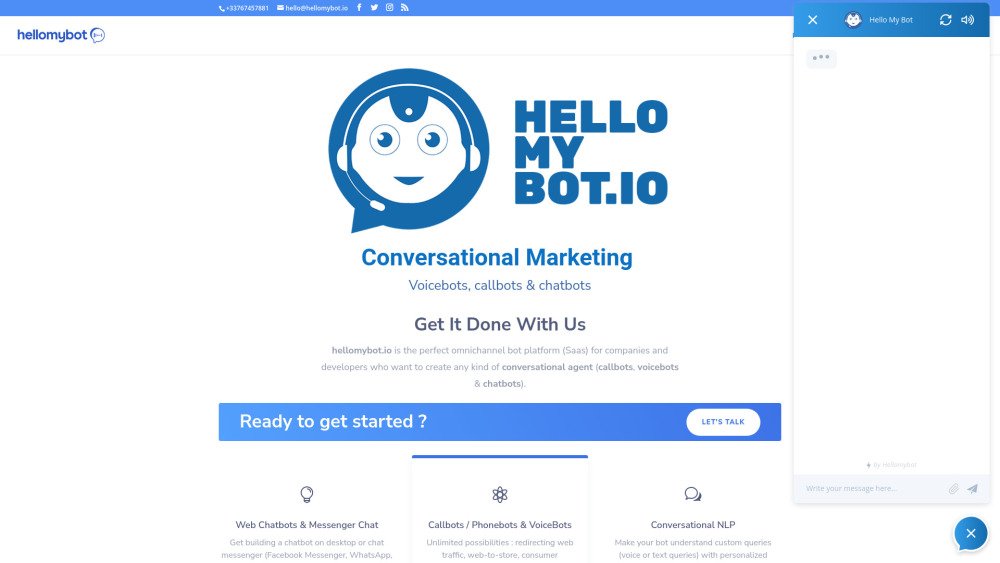
hellomybot.io is a conversational agent platform designed for companies and developers to build callbots, voicebots, and chatbots. It offers an omnichannel bot platform (SaaS) to create various conversational agents, enabling businesses to automate marketing, sales, and support interactions. The platform integrates with existing enterprise and CRM systems, providing 24/7 consumer service and reducing human support costs.
Use hellomybot.io to design conversational flows, integrate with various channels—such as web, messaging apps, and phone—and analyze user behavior. Create virtual assistants for marketing, sales, and support to automate conversations while maintaining a personal touch.
You can build callbots, voicebots, and chatbots for multiple channels, including web, messaging apps, and phone.
Yes, hellomybot.io integrates with existing enterprise and CRM platforms, as well as e-commerce solutions like Shopify, Magento, and Prestashop.
hellomybot.io provides insights into user behavior, helping you better understand your prospects or clients and process the information shared during conversations.
Free plan available.
Use these comparison pages to understand the trade-offs between the models most relevant to hellomybot.io.
Compare Gemini 1.0 Pro Deprecated and Gemini 2.0 Flash across pricing, context window, capabilities, benchmarks, and API access to choose the better fit for long-context workloads versus long-context workloads.
Compare Gemini 1.0 Pro Deprecated and Gemini 2.5 Flash across pricing, context window, capabilities, benchmarks, and API access to choose the better fit for long-context workloads versus long-context workloads.
Compare Gemini 2.0 Flash Lite and Gemini 2.0 Flash across pricing, context window, capabilities, benchmarks, and API access to choose the better fit for long-context workloads versus long-context workloads.
Compare Gemini 2.5 Flash and Gemini 2.0 Flash across pricing, context window, capabilities, benchmarks, and API access to choose the better fit for long-context workloads versus long-context workloads.