
Free
$0Free plan available.
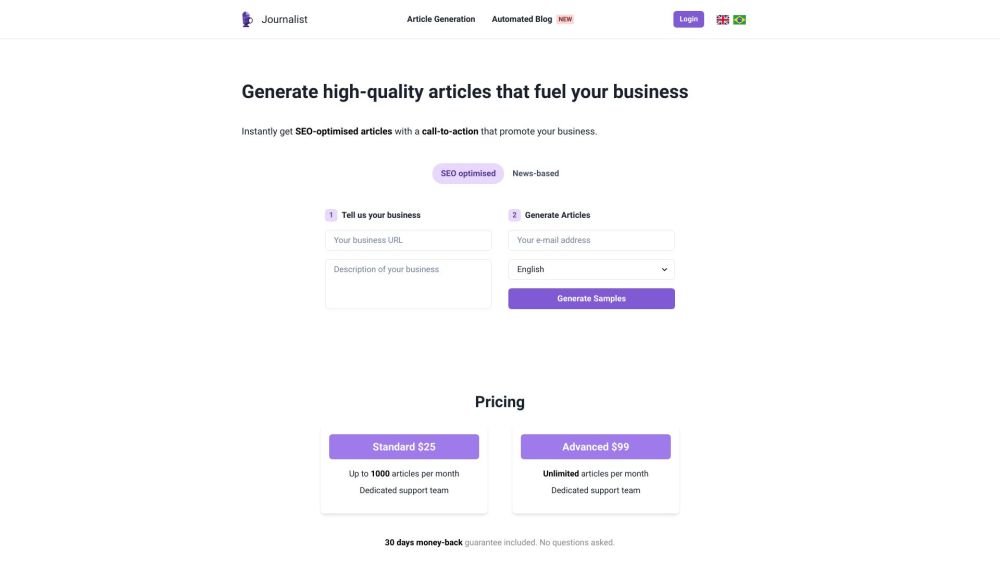
Arvow, formerly known as Journalist AI, is an AI-powered article writer and autoblogging platform built for SEO. It generates articles complete with images, videos, and links, and automatically publishes them to your website to help improve search engine rankings. Key features include AI writing, SEO editing, autoblogging, automatic indexing, and social syndication. Arvow integrates with platforms like WordPress, Shopify, and Wix, serving e-commerce brands, agencies, SaaS companies, and local businesses.
To use Arvow, provide information about your business or product. The AI writer will generate articles based on your chosen keywords, titles, or descriptions. You can then customize the outline, add a call-to-action (CTA), and select your preferred language, tone, and geo-targeting. Finally, generate and publish multiple articles at once, or use the AutoBlog feature to automate the process.
Yes. The content is entirely AI-generated, which prevents the replication of existing content and avoids triggering plagiarism detection.
Google can detect AI content, but its primary focus is on content quality. Google rewards high-quality, helpful content regardless of how it is produced, evaluating it based on E-E-A-T (Experience, Expertise, Authoritativeness, and Trustworthiness). Arvow allows you to upload your own knowledge base to provide unique context and insights, ensuring the content remains genuinely helpful.
Yes. You can edit articles directly within the platform using our AI editor, or save them as drafts within your connected integration.
Yes. The article structure is fully customizable. You can configure settings to consistently include specific elements, such as an introduction or an FAQ section at the end.
Yes. We offer Zapier integrations to connect with thousands of platforms. Additionally, the Agency plan provides API access for more granular control. We recommend developer assistance for these integrations.
Yes. Once generated, you can publish posts directly to your website. Arvow integrates with platforms including WordPress, Shopify, Ghost, Wix, Webflow, and Blogger.
Yes. While many tools can generate SEO-optimized articles quickly, it is important to incorporate your own knowledge and first-party information to ensure the content is helpful. Arvow allows you to integrate your knowledge base to provide unique perspectives, ensuring your content is original, SEO-optimized, and reflects your brand's authority.
Yes. You can generate content for any niche or business and manage multiple integrations or AutoBlogs under a single account.
Yes. Generated posts include in-article images, a featured image, internal and external links, bulleted lists, tables, and embedded videos.
Yes. You can manage links by editing the articles within the platform or by publishing them as drafts to your chosen integration.
No. Google does not penalize high-quality content that keeps readers engaged, which is the primary goal of our AI.
It passes most of them. Search engines prioritize valuable content over the method of creation. Because our content is designed to be high-tier and valuable to readers, it receives the appropriate search engine recognition. AI detectors are of limited utility in an AI-integrated landscape.
AI-generated content is derived from existing human-produced works. Because AI outputs are unpredictable and based on user prompts and unique knowledge, they do not meet the U.S. Copyright Office's requirement of human authorship for copyright protection.
Unlike generic AI tools that often require significant manual effort to produce relevant content, Arvow is designed to be effortless. You can generate hundreds of high-quality, business-relevant articles with a single click.
By connecting your Google account, we automatically submit your published articles to Google Search Console to help ensure they are indexed as quickly as possible.
Free plan available.
Use these comparison pages to understand the trade-offs between the models most relevant to Arvow.
Compare Gemini 1.0 Pro Deprecated and Gemini 2.0 Flash across pricing, context window, capabilities, benchmarks, and API access to choose the better fit for long-context workloads versus long-context workloads.
Compare Gemini 1.0 Pro Deprecated and Gemini 2.5 Flash across pricing, context window, capabilities, benchmarks, and API access to choose the better fit for long-context workloads versus long-context workloads.
Compare Gemini 2.0 Flash Lite and Gemini 2.0 Flash across pricing, context window, capabilities, benchmarks, and API access to choose the better fit for long-context workloads versus long-context workloads.
Compare Gemini 2.5 Flash and Gemini 2.0 Flash across pricing, context window, capabilities, benchmarks, and API access to choose the better fit for long-context workloads versus long-context workloads.

Similar AI tool in the AI Image Generator category.
Similar AI tool in the AI Marketing category.
Similar AI tool in the AI Writing Assistants category.
Similar AI tool in the AI Image Generator category.
Similar AI tool in the No-Code&Low-Code category.
Similar AI tool in the AI Assistant category.
Similar AI tool in the AI Chatbot category.
Similar AI tool in the AI Writing Assistants category.
Similar AI tool in the AI Assistant category.
Similar AI tool in the AI Chatbot category.
Similar AI tool in the AI Chatbot category.
Similar AI tool in the AI Writing Assistants category.