
Free
$0Free plan available.
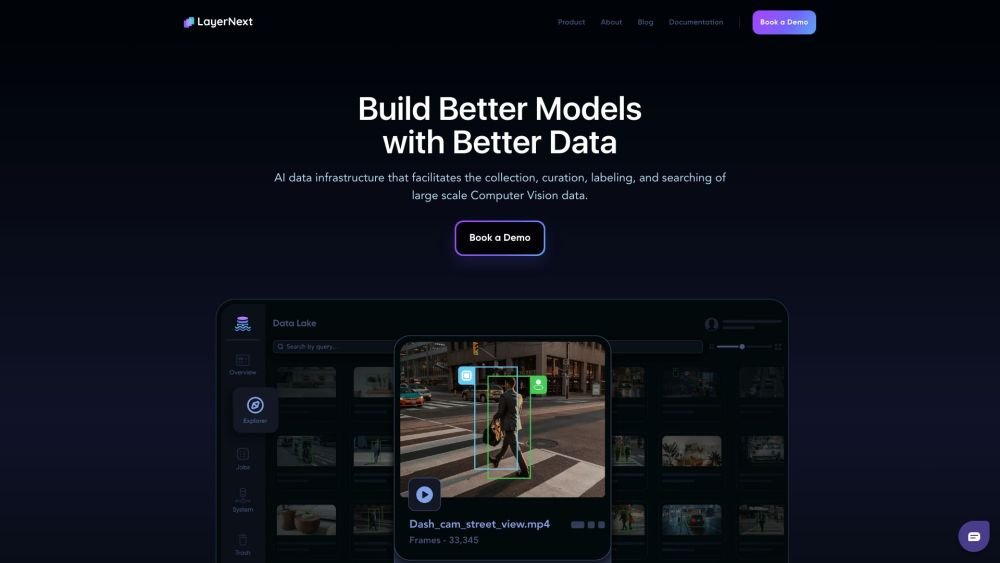
LayerNext is an end-to-end AI data management platform specifically designed for Computer Vision. It provides a unified infrastructure to capture, store, index, search, curate, annotate, and manage large-scale computer vision data, including raw video/image data, metadata, labels, and model runs. The platform facilitates the entire CV workflow from data collection to experiment tracking and production monitoring, aiming to supercharge AI team productivity and collaboration.
LayerNext allows users to upload raw video and image data, then curate and annotate it using the Annotation Studio. Datasets can be managed with version control through the Dataset Manager. Users can explore and visualize all data in a single DataLake, organize unstructured datasets, analyze training data effectiveness, and integrate with other computer vision applications via SDK and API to automate pipelines.
LayerNext is an end-to-end AI data management platform that helps computer vision teams collect, curate, label, and search datasets at scale.
LayerNext includes a DataLake for unified data storage, an Annotation Studio for labeling, and a Dataset Manager for version-controlled dataset management, alongside tools for data exploration, organization, analysis, and integration.
Yes, LayerNext is self-hosted by default, which allows users to deploy it within their own infrastructure for improved security and data control.
LayerNext supports AI applications across various industries, including retail, agriculture, healthcare, and construction.
Yes, LayerNext provides a Community version.
Free plan available.
Use these comparison pages to understand the trade-offs between the models most relevant to LayerNext.
Compare Claude 4.6 Sonnet and Grok 4.3 across pricing, context window, capabilities, benchmarks, and API access to choose the better fit for long-context workloads versus long-context workloads.
Compare DeepSeek V4 Pro and Grok 4.3 across pricing, context window, capabilities, benchmarks, and API access to choose the better fit for long-context workloads versus long-context workloads.
Compare Gemini 3.1 Pro and Grok 4.3 across pricing, context window, capabilities, benchmarks, and API access to choose the better fit for long-context workloads versus long-context workloads.
Compare GPT 5.5 and Grok 4.3 across pricing, context window, capabilities, benchmarks, and API access to choose the better fit for long-context workloads versus long-context workloads.

Similar AI tool in the AI Copilot category.
Similar AI tool in the AI Assistant category.
Similar AI tool in the AI Productivity Tools category.
Similar AI tool in the AI Assistant category.
Similar AI tool in the AI Writing Assistants category.
Similar AI tool in the AI Writing Assistants category.
Similar AI tool in the AI Writing Assistants category.
Similar AI tool in the AI Assistant category.
Similar AI tool in the AI Assistant category.
Similar AI tool in the AI Chatbot category.
Similar AI tool in the AI Chatbot category.
Similar AI tool in the AI Productivity Tools category.