
Free
$0Free plan available.
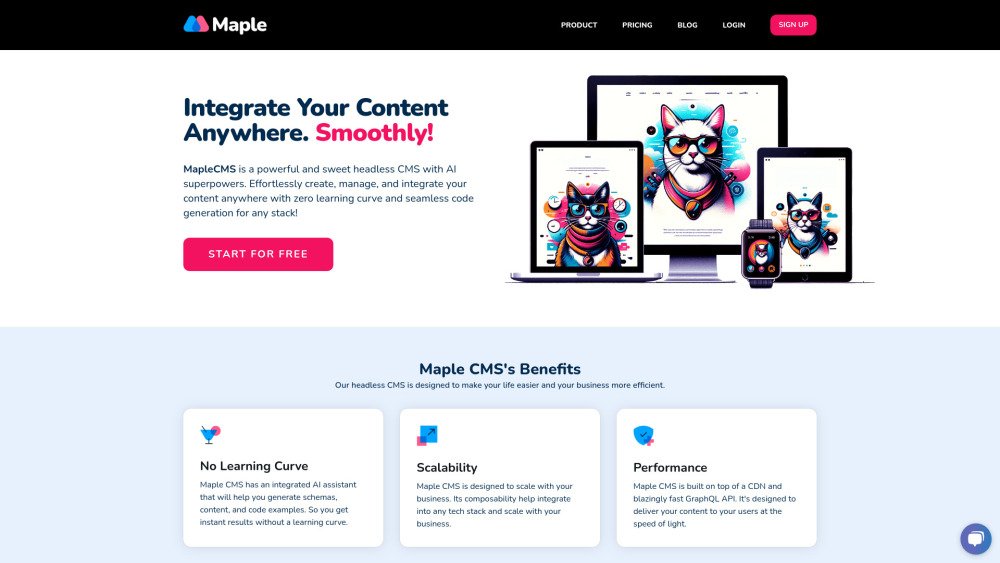
Maple CMS is a headless content management system enhanced with AI capabilities. It enables users to create, manage, and integrate content across any platform with a low learning curve and automated code generation for various tech stacks. Designed for developers, content creators, marketers, and business owners, it features an AI assistant, scalable architecture, and a high-performance GraphQL API.
To use Maple CMS, define your schemas, create content entries based on those schemas, manage assets within the CDN, integrate your content using the GraphQL API, and utilize the AI assistant to support each step of the process.
Maple CMS is a headless content management system with AI capabilities that allows you to create, manage, and integrate your content across any platform.
Maple CMS provides a low learning curve, scalability, and high performance through its integrated AI assistant, composable architecture, CDN, and GraphQL API.
Maple CMS is designed to support developers, content creators, marketers, and business owners.
Maple CMS functions by allowing you to define schemas, create content, manage assets, integrate via the GraphQL API, and use AI to assist with each stage of development.
Free plan available.
Use these comparison pages to understand the trade-offs between the models most relevant to Maple CMS.
Compare Gemini 1.0 Pro Deprecated and Gemini 2.0 Flash across pricing, context window, capabilities, benchmarks, and API access to choose the better fit for long-context workloads versus long-context workloads.
Compare Gemini 1.0 Pro Deprecated and Gemini 2.5 Flash across pricing, context window, capabilities, benchmarks, and API access to choose the better fit for long-context workloads versus long-context workloads.
Compare Gemini 2.0 Flash Lite and Gemini 2.0 Flash across pricing, context window, capabilities, benchmarks, and API access to choose the better fit for long-context workloads versus long-context workloads.
Compare Gemini 2.5 Flash and Gemini 2.0 Flash across pricing, context window, capabilities, benchmarks, and API access to choose the better fit for long-context workloads versus long-context workloads.