
Free
$0Free plan available.
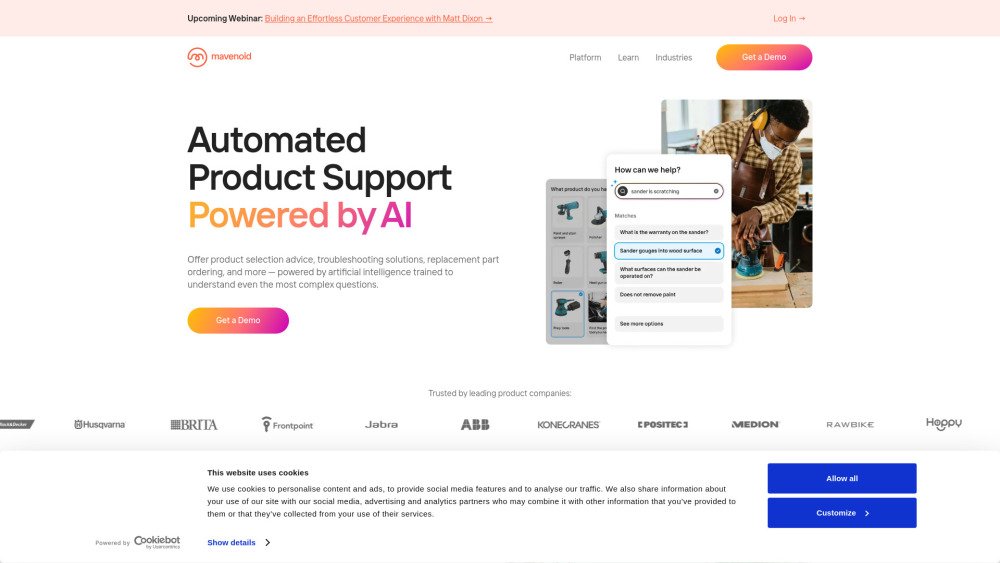
Mavenoid is a dedicated Product CX platform that uses AI to manage product support, including complex scenarios. It drives efficiency, reduces costs, and supports growth through every interaction. The platform provides a Virtual Assistant, a Dynamic Help Center, and Voice Assist to ensure consistent, AI-driven support across all customer touchpoints.
Mavenoid enables you to sync content from multiple sources, integrate with your existing tools, scale translations, and publish consistent support across voice and digital channels. You can use its analytics to optimize the support journey and leverage the no-code builder to implement insights quickly.
Mavenoid is a dedicated Product CX platform that uses AI to manage product support, including complex scenarios.
Core features include a Virtual Assistant, a Dynamic Help Center, and Voice Assist, which provide consistent, AI-driven support experiences.
Mavenoid serves consumer companies, industrial companies, medical device manufacturers, and retailers.
Mavenoid connects with tools such as CCaaS platforms, CRM, PIM, ERP, and IoT systems to share data in real-time.
Free plan available.
Use these comparison pages to understand the trade-offs between the models most relevant to Mavenoid.
Compare Gemini 1.0 Pro Deprecated and Gemini 2.0 Flash across pricing, context window, capabilities, benchmarks, and API access to choose the better fit for long-context workloads versus long-context workloads.
Compare Gemini 1.0 Pro Deprecated and Gemini 2.5 Flash across pricing, context window, capabilities, benchmarks, and API access to choose the better fit for long-context workloads versus long-context workloads.
Compare Gemini 2.0 Flash Lite and Gemini 2.0 Flash across pricing, context window, capabilities, benchmarks, and API access to choose the better fit for long-context workloads versus long-context workloads.
Compare Gemini 2.5 Flash and Gemini 2.0 Flash across pricing, context window, capabilities, benchmarks, and API access to choose the better fit for long-context workloads versus long-context workloads.