
Free
$0Free plan available.
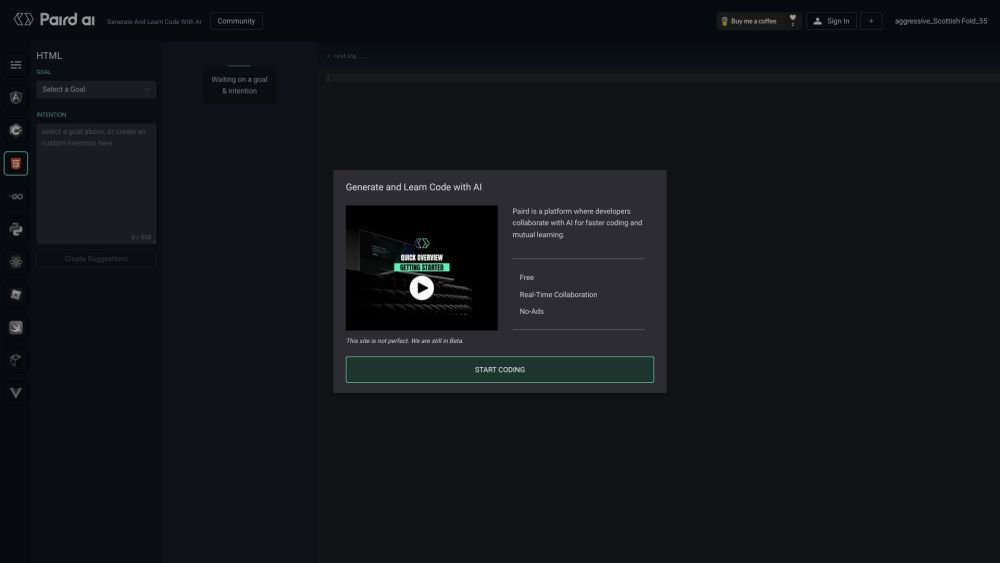
Paird.ai is a platform designed to accelerate code generation and enhance collaboration among developers. It allows users to generate code 10x faster, learn as they go, and collaborate in real-time. It caters to both experienced professionals and newcomers, offering features like visual prompt engineering, multiple language support, AI-driven code evaluation, and real-time communication tools.
Users can start by creating an account and then use the platform's visual interface to engineer prompts and generate code. They can collaborate with team members in real-time, utilize AI-driven code evaluations, and choose from multiple language models to refine their code.
Paird.ai provides a unique combination of collaboration features and AI-driven capabilities, such as visual prompt engineering, automated code evaluation, and real-time communication tools, to enhance the development process.
Real-time collaboration enables team members to work simultaneously, share insights, and resolve issues more efficiently, which helps shorten development cycles and improve overall code quality.
Access to multiple LLMs allows users to select the most suitable model for their specific requirements, thereby optimizing code generation and problem-solving performance.
AI-driven code evaluation offers feedback on bugs, code structure, functionality, readability, and efficiency, assisting developers in identifying areas for growth and refining their technical skills.
Paird.ai integrates AI-powered code generation, real-time collaboration, and comprehensive evaluation tools to streamline development workflows and enable developers to build software more efficiently.
Free plan available.
Use these comparison pages to understand the trade-offs between the models most relevant to Paird.ai.
Compare Gemini 1.0 Pro Deprecated and Gemini 2.0 Flash across pricing, context window, capabilities, benchmarks, and API access to choose the better fit for long-context workloads versus long-context workloads.
Compare Gemini 1.0 Pro Deprecated and Gemini 2.5 Flash across pricing, context window, capabilities, benchmarks, and API access to choose the better fit for long-context workloads versus long-context workloads.
Compare Gemini 2.0 Flash Lite and Gemini 2.0 Flash across pricing, context window, capabilities, benchmarks, and API access to choose the better fit for long-context workloads versus long-context workloads.
Compare Gemini 2.5 Flash and Gemini 2.0 Flash across pricing, context window, capabilities, benchmarks, and API access to choose the better fit for long-context workloads versus long-context workloads.

Similar AI tool in the AI Copilot category.
Similar AI tool in the AI Assistant category.
Similar AI tool in the AI Assistant category.
Similar AI tool in the AI Productivity Tools category.
Similar AI tool in the AI Assistant category.
Similar AI tool in the AI Assistant category.
Similar AI tool in the AI Assistant category.
Similar AI tool in the AI Chatbot category.
Similar AI tool in the AI Productivity Tools category.
Similar AI tool in the AI Assistant category.
Similar AI tool in the AI Chatbot category.
Similar AI tool in the AI Assistant category.