Pinecone

2
5 0 Reviews 2 Saved
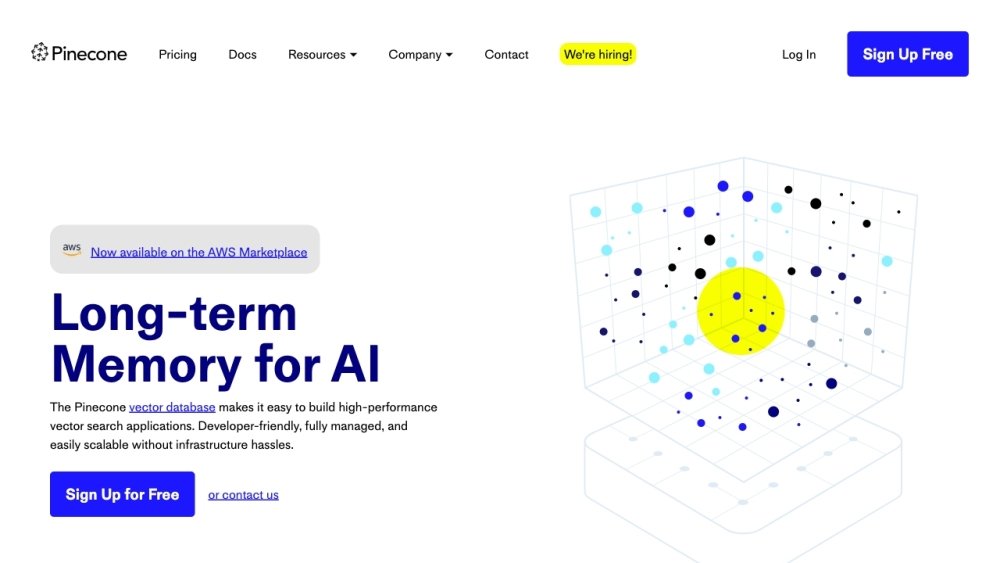
Introduction: Pinecone: Pinecone is a vector database designed to make vector search fast and easy, transitioning it from research to production without the need for DevOps. It allows users to manage and search through vector embeddings to power semantic search, recommenders, and other applications that rely on relevant information retrieval. Pinecone offers a scalable solution for building knowledgeable AI, enabling users to search through billions of items for similar matches in milliseconds.
Monthly Visitors: 565.4K

Pinecone Product Information

What is Pinecone?

Pinecone is a managed vector database service engineered for AI applications. It enables developers to build scalable semantic search, recommendation systems, and data retrieval systems (RAG) for LLMs. By handling the complex infrastructure of vector storage, Pinecone allows teams to focus on building AI features rather than managing databases.

How to use Pinecone?

  1. Create an index in the Pinecone console.
  2. Convert your data (text, images) into vectors using an embedding model.
  3. Upsert these vectors into your Pinecone index.
  4. Query the index with a new vector to find the most similar items instantly.

Pinecone's Core Features

  • "[\"Vector search\",\"Semantic search\",\"Hybrid search (sparse and dense embeddings)\",\"Real-time indexing\",\"Metadata filtering\",\"Serverless scaling\",\"Managed infrastructure\"]"

Pinecone Use Cases

#1 "[\"Building 'Knowledge Bases' for ChatGPT (RAG)\",\"Implementing semantic search for e-commerce sites\",\"Creating content recommendation engines\",\"Detecting anomalies in data streams\"]"

Related Model Comparison Pages

Use these comparison pages to understand the trade-offs between the models most relevant to Pinecone.

Compare GPT 5.4 and GPT 5.4 Pro across pricing, context window, capabilities, benchmarks, and API access to choose the better fit for long-context workloads versus long-context workloads.

Compare GPT 5.5 and GPT 5.4 across pricing, context window, capabilities, benchmarks, and API access to choose the better fit for long-context workloads versus long-context workloads.

Compare GPT 5.5 and Claude 4.6 Opus across pricing, context window, capabilities, benchmarks, and API access to choose the better fit for long-context workloads versus long-context workloads.

Compare GPT 5.5 and Claude 4.6 Sonnet across pricing, context window, capabilities, benchmarks, and API access to choose the better fit for long-context workloads versus long-context workloads.