
Free
$0Free plan available.
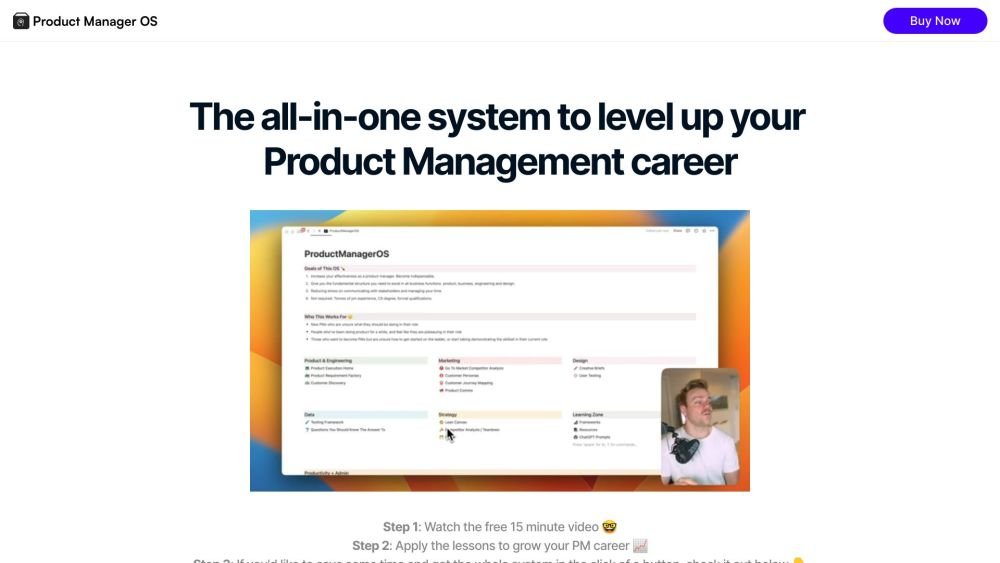
Product Manager OS is a comprehensive system designed to manage the entire product management lifecycle. From customer discovery and go-to-market planning to product execution, this AI-assisted toolkit helps you move from hypothesis to a finished product. It provides product managers with best practices, systematized processes, and customizable components to advance their careers. Key features include development management, customer discovery tools, A/B testing frameworks, competitor analysis templates, go-to-market planning systems, and various strategy templates, all supported by integrated explainer videos.
Upon purchase, you will receive a link to access the system. All explainer videos are embedded directly within the platform. You can apply the lessons from these videos to advance your career and utilize the system's built-in features to manage your daily product management tasks.
Once purchased, you will receive a link to access the system. All explainer videos are embedded directly within the platform.
No, you can access 95% of the functionality using the free plan. To utilize certain AI features, you may need to upgrade to Notion AI, which is available at an additional cost.
Yes. If you have a professional development or education budget, you should be able to expense this product. Otherwise, a brief email to your manager outlining the benefits is usually sufficient.
Value is subjective, but this is an investment in your career. A structured system is essential for a product manager's success and long-term earning potential, and many users have found it to be a worthwhile investment.
Free plan available.
Use these comparison pages to understand the trade-offs between the models most relevant to Product Manager OS.
Compare Gemini 1.0 Pro Deprecated and Gemini 2.0 Flash across pricing, context window, capabilities, benchmarks, and API access to choose the better fit for long-context workloads versus long-context workloads.
Compare Gemini 1.0 Pro Deprecated and Gemini 2.5 Flash across pricing, context window, capabilities, benchmarks, and API access to choose the better fit for long-context workloads versus long-context workloads.
Compare Gemini 2.0 Flash Lite and Gemini 2.0 Flash across pricing, context window, capabilities, benchmarks, and API access to choose the better fit for long-context workloads versus long-context workloads.
Compare Gemini 2.5 Flash and Gemini 2.0 Flash across pricing, context window, capabilities, benchmarks, and API access to choose the better fit for long-context workloads versus long-context workloads.

Similar AI tool in the AI Assistant category.
Similar AI tool in the AI Productivity Tools category.
Similar AI tool in the AI Marketing category.
Similar AI tool in the AI Writing Assistants category.
Similar AI tool in the AI Assistant category.
Similar AI tool in the AI Writing Assistants category.
Similar AI tool in the AI Writing Assistants category.
Similar AI tool in the AI Assistant category.
Similar AI tool in the AI Assistant category.
Similar AI tool in the AI Chatbot category.
Similar AI tool in the No-Code&Low-Code category.
Similar AI tool in the AI Productivity Tools category.