
Free
$0Free plan available.
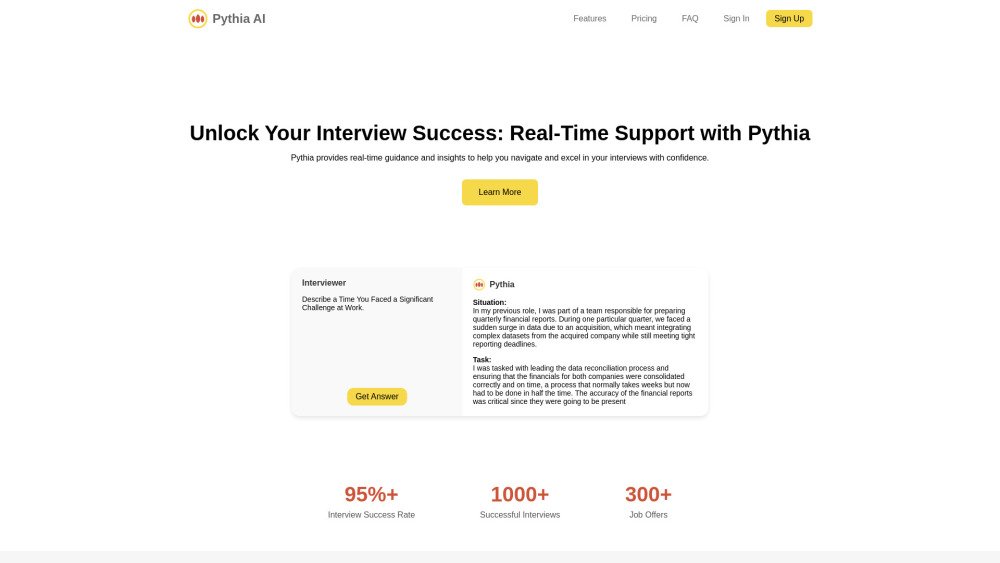
Pythia AI is an interview assistance tool designed to help job seekers succeed in interviews. It delivers real-time, structured, and actionable responses to interview questions, featuring AI-driven personalization and industry-specific insights to support users during their sessions.
Register for a Pythia AI account and utilize the platform during your interviews to receive real-time guidance. The AI generates tailored responses and provides industry-specific knowledge to help you answer questions effectively.
While not explicitly defined, it is an AI-powered tool designed to assist users during job interviews by offering real-time guidance and structured answers.
It assists by providing real-time guidance, personalized responses, and industry-specific knowledge to help users answer questions effectively.
The platform supports all online meeting services.
The platform provides access to extensive industry knowledge, indicating support for a wide range of domains and industries.
The platform states that interviewers will not detect any background processes, maintaining user confidentiality and privacy.
Information regarding the cancellation policy is not provided on the website.
Free plan available.
Use these comparison pages to understand the trade-offs between the models most relevant to Pythia AI.
Compare Gemini 1.0 Pro Deprecated and Gemini 2.0 Flash across pricing, context window, capabilities, benchmarks, and API access to choose the better fit for long-context workloads versus long-context workloads.
Compare Gemini 1.0 Pro Deprecated and Gemini 2.5 Flash across pricing, context window, capabilities, benchmarks, and API access to choose the better fit for long-context workloads versus long-context workloads.
Compare Gemini 2.0 Flash Lite and Gemini 2.0 Flash across pricing, context window, capabilities, benchmarks, and API access to choose the better fit for long-context workloads versus long-context workloads.
Compare Gemini 2.5 Flash and Gemini 2.0 Flash across pricing, context window, capabilities, benchmarks, and API access to choose the better fit for long-context workloads versus long-context workloads.