
Free
$0Free plan available.
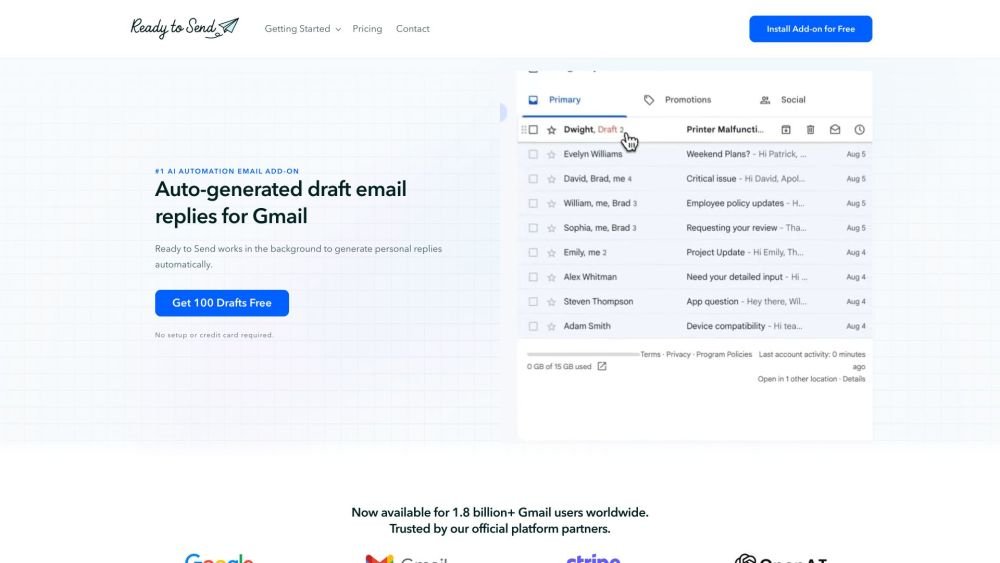
Ready to Send is an AI-powered email assistant for Gmail that generates personalized draft replies automatically. It works in the background, identifying new emails and creating complete draft responses tailored to specific conversations. It manages your inbox by generating contextual, human-like replies in your own voice and style, helping you save time and increase productivity.
Install the Ready to Send Gmail app from the Google Workspace Marketplace. Once installed, the app runs in the background to automatically generate draft replies for new emails. You can then review, edit, or regenerate these drafts before sending.
Ready to Send is a Gmail app available via the Google Workspace Marketplace. Refer to the getting started guide for detailed installation steps.
Yes. Your privacy and data security are prioritized. Ready to Send complies with all relevant data protection regulations. By utilizing Google's infrastructure, the service ensures that emails are not stored and AI language models are not trained on your personal messages.
Yes, Ready to Send integrates natively with the Gmail app on both Android and iOS, allowing you to maintain productivity while on the go.
Yes, Ready to Send supports over 100 languages. It automatically detects the language of the incoming email and generates an appropriate response.
Ready to Send scans your inbox for new, unread emails that require a reply. It is designed to ignore newsletters, updates, and promotional content, focusing only on relevant correspondence.
Yes. You can set global instructions or tailor them for specific email addresses. This allows you to adjust your writing style for different contacts to ensure your responses remain authentic.
Free plan available.
Use these comparison pages to understand the trade-offs between the models most relevant to Ready to Send.
Compare Gemini 1.0 Pro Deprecated and Gemini 2.0 Flash across pricing, context window, capabilities, benchmarks, and API access to choose the better fit for long-context workloads versus long-context workloads.
Compare Gemini 1.0 Pro Deprecated and Gemini 2.5 Flash across pricing, context window, capabilities, benchmarks, and API access to choose the better fit for long-context workloads versus long-context workloads.
Compare Gemini 2.0 Flash Lite and Gemini 2.0 Flash across pricing, context window, capabilities, benchmarks, and API access to choose the better fit for long-context workloads versus long-context workloads.
Compare Gemini 2.5 Flash and Gemini 2.0 Flash across pricing, context window, capabilities, benchmarks, and API access to choose the better fit for long-context workloads versus long-context workloads.

Similar AI tool in the AI Agent category.
Similar AI tool in the AI Image Generator category.
Similar AI tool in the AI Marketing category.
Similar AI tool in the AI Assistant category.
Similar AI tool in the AI Image Generator category.
Similar AI tool in the No-Code&Low-Code category.
Similar AI tool in the AI Chatbot category.
Similar AI tool in the AI Writing Assistants category.
Similar AI tool in the AI Assistant category.
Similar AI tool in the AI Chatbot category.
Similar AI tool in the AI Design Generator category.
Similar AI tool in the AI Art Generator category.