ResearchGPT

6
5 0 Reviews 6 Saved
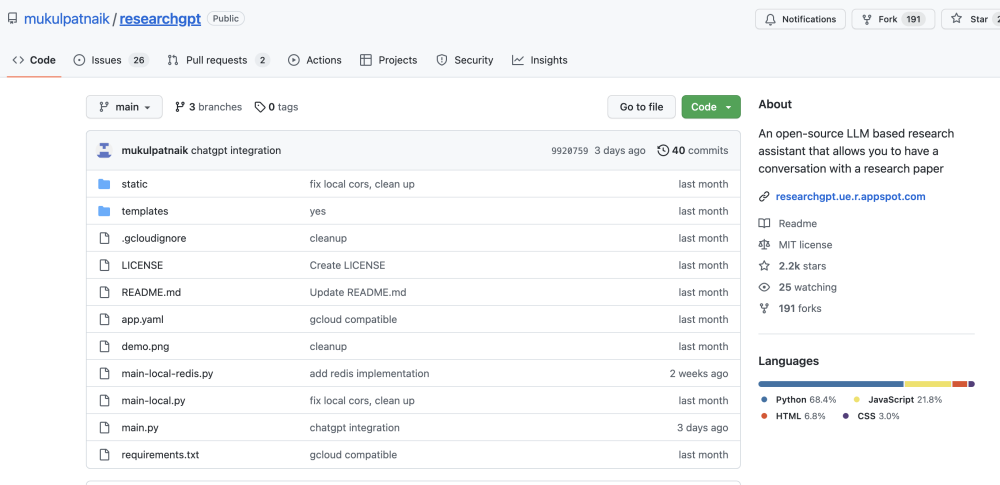
Introduction: ResearchGPT is a FastAPI-based application that enables interactive conversations with research papers. Users can upload PDF files or provide direct links to online documents. The tool extracts text, creates embeddings, and leverages the OpenAI API to answer questions based on the paper's content, while citing the specific source text and page number for each response.

ResearchGPT Product Information

What is ResearchGPT?

ResearchGPT is a FastAPI application designed to facilitate conversations with research papers. It allows users to upload PDF documents or provide links to online PDFs. The application extracts text from the PDF, generates embeddings, and uses the OpenAI API to answer user questions based on the content of the paper. It also provides the source text and page number used to generate the response.

How to use ResearchGPT?

Users can upload a PDF file or provide a link to an online PDF. Once the document is processed, users can ask questions about the paper, and ResearchGPT will generate answers based on the document content, including relevant source citations.

ResearchGPT's Core Features

  • PDF text extraction
  • Embedding generation
  • Question answering using OpenAI API
  • Source and page number referencing

ResearchGPT Use Cases

#1 Quickly understand the key points of a research paper.
#2 Find specific information within a research paper through conversation.
#3 Summarize sections of a research paper.

FAQ from ResearchGPT

How do I install ResearchGPT? +

Clone the repository, navigate to the project directory, and run 'pip install -r requirements.txt'. You must also install and run Redis to handle local embedding storage.

What do I need to use ResearchGPT? +

You require an OpenAI API key and a local instance of Redis installed and running.

Where can I get an OpenAI API key? +

You can obtain an OpenAI API key by visiting https://platform.openai.com/account/api-keys.

Related Model Comparison Pages

Use these comparison pages to understand the trade-offs between the models most relevant to ResearchGPT.

Compare GPT 5.4 and GPT 5.4 Pro across pricing, context window, capabilities, benchmarks, and API access to choose the better fit for long-context workloads versus long-context workloads.

Compare GPT 5.5 and GPT 5.4 across pricing, context window, capabilities, benchmarks, and API access to choose the better fit for long-context workloads versus long-context workloads.

Compare GPT 5.5 and Claude 4.6 Opus across pricing, context window, capabilities, benchmarks, and API access to choose the better fit for long-context workloads versus long-context workloads.

Compare GPT 5.5 and Claude 4.6 Sonnet across pricing, context window, capabilities, benchmarks, and API access to choose the better fit for long-context workloads versus long-context workloads.