
Free
$0Free plan available.
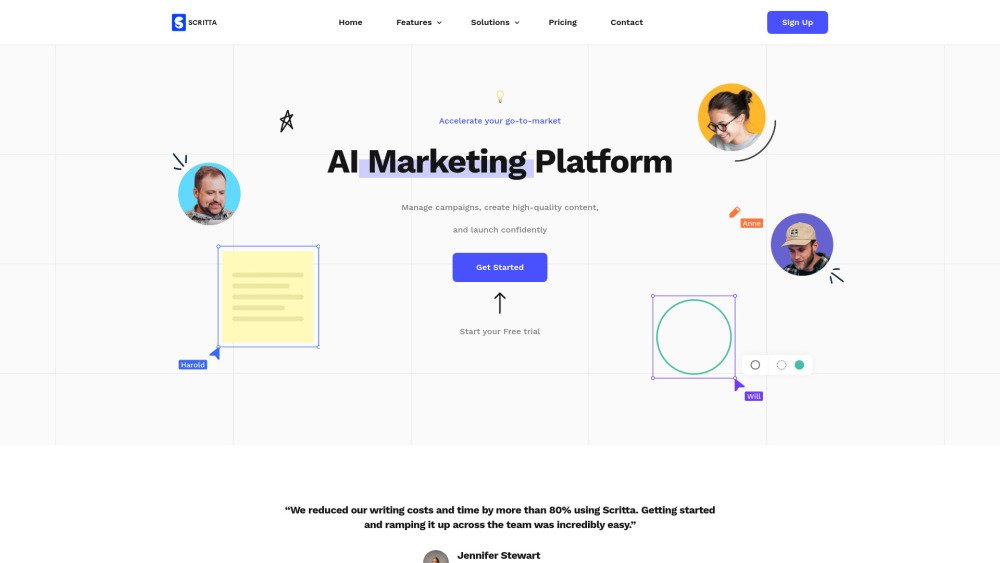
Scritta is an AI marketing platform designed to transform marketing campaigns and content generation workflows. It streamlines content planning, creation, and management, aiming to make tasks more manageable and results more impactful. Scritta leverages AI models to create unique brand voices by using brand, market, and competitor information to increase content accuracy and maintain brand integrity.
Users can sign up for Scritta to utilize its AI-driven tools for managing campaigns, generating high-quality content via pre-built templates, and tracking performance analytics to enhance outcomes. The platform provides a centralized hub for managing content knowledge, overseeing campaigns, and repurposing content across various channels.
Scritta maintains strict access controls across accounts, ensuring no users outside your workspace can access your data. Independent third parties have audited Scritta to verify that these security measures are effective. Scritta does not share your data with anyone outside of the trusted partners required to provide the service.
Yes, you can upgrade or downgrade your plan at any time. Upgrades result in a prorated charge for the remainder of the month, while downgrades provide a credit toward your next billing cycle.
Yes, Scritta offers a 7-day free trial for Personal or Business plans. You can create an account to explore how Scritta supports your business needs risk-free.
To add more than one user, you must upgrade to the Business plan, which includes one user and supports up to five total. For yearly billing, additional users cost $31/seat/month; for monthly billing, the cost is $39/seat/month. For teams larger than five, contact our sales team to discuss an Enterprise Plan, which includes features like SSO, dedicated team spaces, and custom style guides.
Yes. Paying annually upfront provides approximately 20% savings with a 12-month commitment, while monthly billing is available at a higher rate. Enterprise plans also require a 12-month commitment. You may start a 7-day free trial of the Personal or Business plans to evaluate Scritta before committing to an annual subscription.
Free plan available.
Use these comparison pages to understand the trade-offs between the models most relevant to Scritta.
Compare Gemini 1.0 Pro Deprecated and Gemini 2.0 Flash across pricing, context window, capabilities, benchmarks, and API access to choose the better fit for long-context workloads versus long-context workloads.
Compare Gemini 1.0 Pro Deprecated and Gemini 2.5 Flash across pricing, context window, capabilities, benchmarks, and API access to choose the better fit for long-context workloads versus long-context workloads.
Compare Gemini 2.0 Flash Lite and Gemini 2.0 Flash across pricing, context window, capabilities, benchmarks, and API access to choose the better fit for long-context workloads versus long-context workloads.
Compare Gemini 2.5 Flash and Gemini 2.0 Flash across pricing, context window, capabilities, benchmarks, and API access to choose the better fit for long-context workloads versus long-context workloads.

Similar AI tool in the AI Assistant category.
Similar AI tool in the AI Productivity Tools category.
Similar AI tool in the AI Writing Assistants category.
Similar AI tool in the AI Marketing category.
Similar AI tool in the AI Assistant category.
Similar AI tool in the AI Assistant category.
Similar AI tool in the AI Writing Assistants category.
Similar AI tool in the AI Writing Assistants category.
Similar AI tool in the AI Assistant category.
Similar AI tool in the AI Assistant category.
Similar AI tool in the AI Chatbot category.
Similar AI tool in the AI Marketing category.