
Free
$0Free plan available.
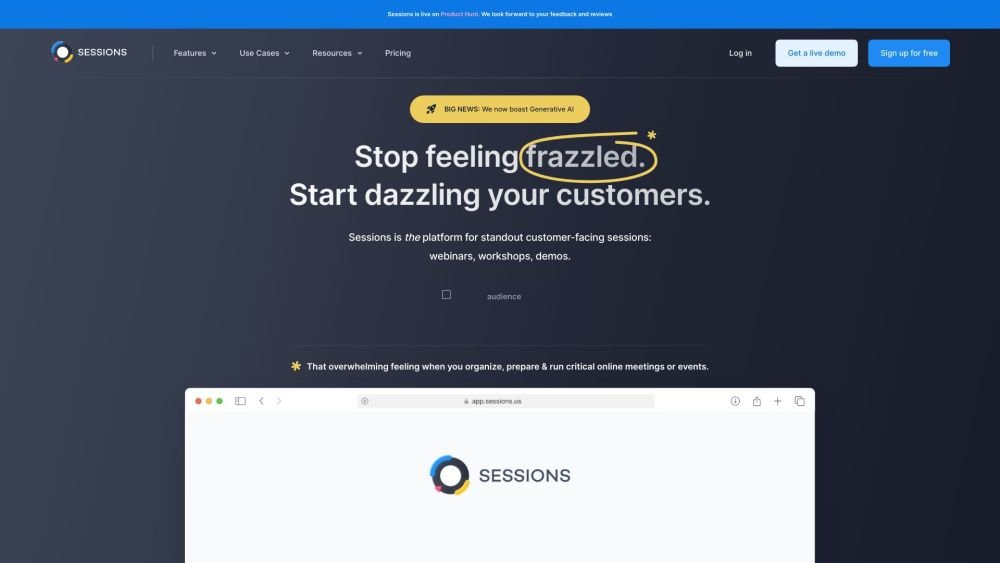
Sessions is a platform redefining hybrid communication by integrating collaboration tools into one place. It offers a unique agenda designer for organized and on-time sessions, regardless of format or complexity. Sessions provides features like scheduling, transcripts, rooms, cloud storage, and AI on a single platform, enabling interactive meetings and webinars. It allows users to create interactive agendas, embed tools, and manage webinars efficiently with AI Copilot. Sessions also supports team collaboration, event management, and secure data storage.
Use Sessions to schedule meetings, create interactive agendas, host webinars, and collaborate with your team. Sync your calendar, embed tools, and utilize the AI Copilot for efficient webinar management. Share resources and access recordings, transcripts, and analytics stored securely in the cloud.
Sessions offers features including interactive agendas, AI Copilot, Ultra HD video and audio, tools and integrations, workspaces, event management, bookings and scheduling, memory and analytics, and privacy and security.
Sessions is designed for sales, marketing, and customer success teams, supporting activities such as discovery calls, interactive demos, webinars, onboarding, and interactive training sessions.
Sessions maintains a strict approach to data security, ensuring no data is shared with third parties or used to train AI models. The platform is supported by Google’s cloud infrastructure with European-based storage and includes session locking to prevent unauthorized access.
The AI Copilot assists in creating, launching, and managing webinars efficiently by automating tasks and providing support throughout your sessions.
Free plan available.
Use these comparison pages to understand the trade-offs between the models most relevant to Sessions.
Compare Gemini 1.0 Pro Deprecated and Gemini 2.0 Flash across pricing, context window, capabilities, benchmarks, and API access to choose the better fit for long-context workloads versus long-context workloads.
Compare Gemini 1.0 Pro Deprecated and Gemini 2.5 Flash across pricing, context window, capabilities, benchmarks, and API access to choose the better fit for long-context workloads versus long-context workloads.
Compare Gemini 2.0 Flash Lite and Gemini 2.0 Flash across pricing, context window, capabilities, benchmarks, and API access to choose the better fit for long-context workloads versus long-context workloads.
Compare Gemini 2.5 Flash and Gemini 2.0 Flash across pricing, context window, capabilities, benchmarks, and API access to choose the better fit for long-context workloads versus long-context workloads.

Similar AI tool in the AI Copilot category.
Similar AI tool in the AI Assistant category.
Similar AI tool in the AI Assistant category.
Similar AI tool in the AI Productivity Tools category.
Similar AI tool in the AI Assistant category.
Similar AI tool in the AI Assistant category.
Similar AI tool in the AI Chatbot category.
Similar AI tool in the AI Assistant category.
Similar AI tool in the AI Chatbot category.
Similar AI tool in the AI Productivity Tools category.
Similar AI tool in the AI Assistant category.
Similar AI tool in the AI Assistant category.