
Free
$0Free plan available.
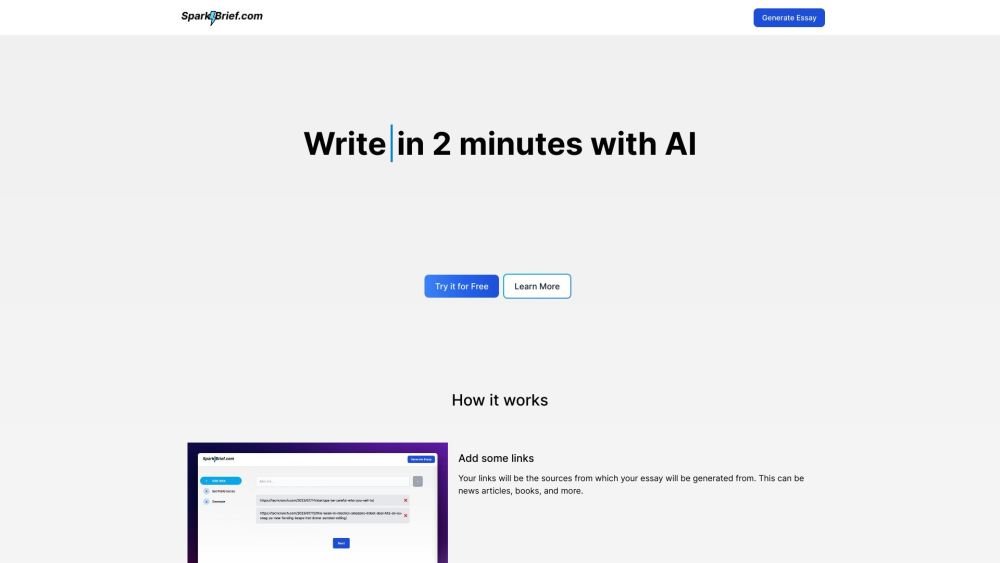
SparkBrief is an AI-assisted essay writer that helps users easily write essays, newsletters, and more. It is powered by GPT and PaLM and allows users to set maximum words, multiple tones, speakers, and objectives for the essay. Users can also add links as sources for the essay generation.
To use SparkBrief, provide source links, configure your preferences for word count, speaker, tone, and objective, and wait 1-2 minutes for the AI to generate your content. No account registration is required.
SparkBrief utilizes GPT (Generative Pre-trained Transformer) from OpenAI and PaLM (Pathways Language Model) from Google. It integrates these APIs to produce results based on your selected preferences.
No, you can use SparkBrief without an account. SparkBrief does not store any personal information on its servers.
The generation process takes approximately 1-2 minutes.
Free plan available.
Use these comparison pages to understand the trade-offs between the models most relevant to SparkBrief.
Compare GPT 5.4 and GPT 5.4 Pro across pricing, context window, capabilities, benchmarks, and API access to choose the better fit for long-context workloads versus long-context workloads.
Compare GPT 5.5 and GPT 5.4 across pricing, context window, capabilities, benchmarks, and API access to choose the better fit for long-context workloads versus long-context workloads.
Compare GPT 5.5 and Claude 4.6 Opus across pricing, context window, capabilities, benchmarks, and API access to choose the better fit for long-context workloads versus long-context workloads.
Compare GPT 5.5 and Claude 4.6 Sonnet across pricing, context window, capabilities, benchmarks, and API access to choose the better fit for long-context workloads versus long-context workloads.

Similar AI tool in the AI Assistant category.
Similar AI tool in the AI Assistant category.
Similar AI tool in the AI Productivity Tools category.
Similar AI tool in the AI Writing Assistants category.
Similar AI tool in the AI Assistant category.
Similar AI tool in the AI Writing Assistants category.
Similar AI tool in the AI Writing Assistants category.
Similar AI tool in the AI Assistant category.
Similar AI tool in the AI Assistant category.
Similar AI tool in the AI Chatbot category.
Similar AI tool in the AI Productivity Tools category.
Similar AI tool in the AI Assistant category.