
Free
$0Free plan available.
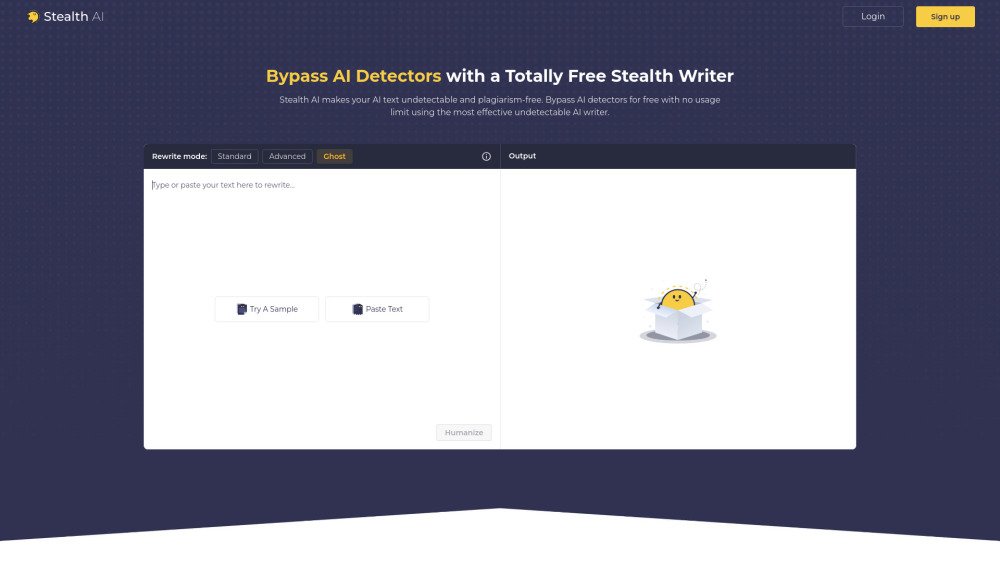
PassMe AI is a stealth writing tool that helps users make AI-generated content undetectable by AI detectors. It uses advanced humanization technology to create human-like, plagiarism-free text. It is designed for students and professionals who need to bypass AI detection for assignments, essays, client writing, company materials, and more.
Users can paste their AI-generated text into PassMe AI, which then humanizes the content to bypass AI detectors. The tool provides various modes—Standard, Advanced, and Ghost—and supports multiple languages. Additionally, users can perform AI detection checks and remove plagiarism.
A stealth AI writer is a tool that creates content designed to remain undetectable by AI content checkers.
PassMe AI can humanize any AI-generated text, including essays, papers, reports, analyses, applications, and emails, regardless of whether it was created by ChatGPT, Gemini, Claude, Jasper, Copy.ai, or other language models.
Yes. Because AI detection false positives are a common issue, PassMe AI can help ensure your human-written content is not incorrectly flagged as AI-generated.
Yes, you can test PassMe AI for free to evaluate its effectiveness.
Free plan available.
Use these comparison pages to understand the trade-offs between the models most relevant to PassMe AI.
Compare Gemini 1.0 Pro Deprecated and Gemini 2.0 Flash across pricing, context window, capabilities, benchmarks, and API access to choose the better fit for long-context workloads versus long-context workloads.
Compare Gemini 1.0 Pro Deprecated and Gemini 2.5 Flash across pricing, context window, capabilities, benchmarks, and API access to choose the better fit for long-context workloads versus long-context workloads.
Compare Gemini 2.0 Flash Lite and Gemini 2.0 Flash across pricing, context window, capabilities, benchmarks, and API access to choose the better fit for long-context workloads versus long-context workloads.
Compare Gemini 2.5 Flash and Gemini 2.0 Flash across pricing, context window, capabilities, benchmarks, and API access to choose the better fit for long-context workloads versus long-context workloads.