
Free
$0Free plan available.
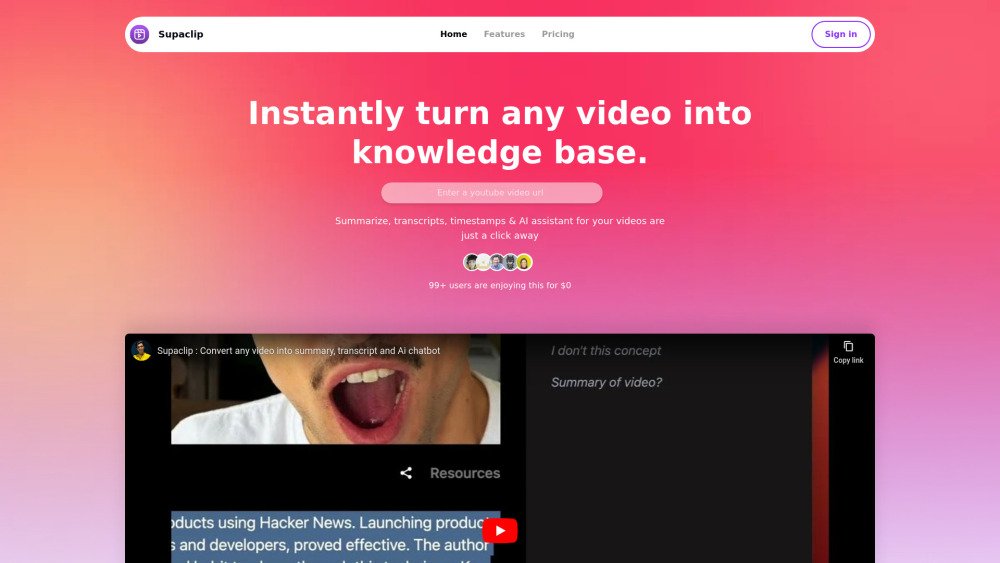
Supaclips transforms videos into searchable knowledge assets such as concise summaries, accurate transcripts, precise timestamps, and an AI-powered assistant trained on the video data. It allows users to instantly create a website from their video with an AI assistant to solve problems. With Supaclips, users can increase video's organic reach by content distribution, extract key insights, quotes, and clips from interview videos and documentaries, and get the most out of long lectures using summary and AI assistant.
Users can summarize videos, chat with an AI assistant trained on the video content, and access complete transcripts with timestamps for easy navigation. Supaclips provides both a free plan and a premium plan for creators.
Supaclips converts videos into searchable knowledge assets, providing concise summaries, accurate transcripts, precise timestamps, and an AI-powered assistant trained on your video data.
The Free Plan includes video summaries, transcripts, timestamps, and an AI chat assistant.
The Premium Plan includes all features from the Free Plan, with the addition of a custom domain.
Free plan available.
Use these comparison pages to understand the trade-offs between the models most relevant to Supaclips.
Compare Gemini 1.0 Pro Deprecated and Gemini 2.0 Flash across pricing, context window, capabilities, benchmarks, and API access to choose the better fit for long-context workloads versus long-context workloads.
Compare Gemini 1.0 Pro Deprecated and Gemini 2.5 Flash across pricing, context window, capabilities, benchmarks, and API access to choose the better fit for long-context workloads versus long-context workloads.
Compare Gemini 2.0 Flash Lite and Gemini 2.0 Flash across pricing, context window, capabilities, benchmarks, and API access to choose the better fit for long-context workloads versus long-context workloads.
Compare Gemini 2.5 Flash and Gemini 2.0 Flash across pricing, context window, capabilities, benchmarks, and API access to choose the better fit for long-context workloads versus long-context workloads.