
Free
$0Free plan available.
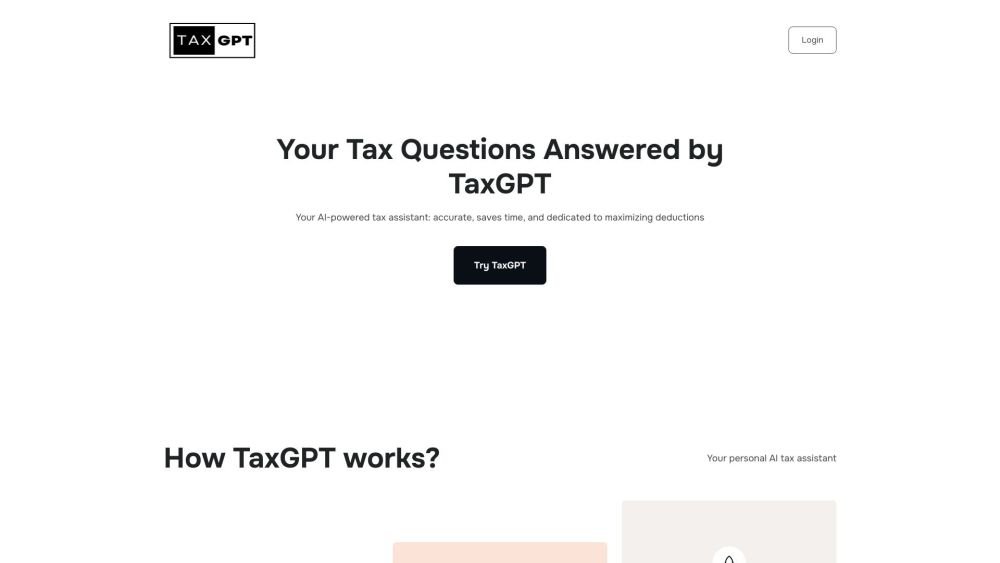
TaxGPT is an AI-powered tax assistant built for accountants and tax professionals. It serves as an AI co-pilot designed to increase productivity, providing secure and accurate solutions to streamline tax operations. Key features include AI-driven tax return reviews, client management tools, and integration capabilities for existing workflows, supported by resources like a blog, professional guidance, and an AI-powered answer library.
To use TaxGPT, sign in and select your persona: Tax professional, Business, or Individual. You will be prompted to answer questions regarding your location, company size (if applicable), and how you discovered the platform. Based on your input, TaxGPT provides options to schedule a Google Meet for a product walkthrough or request a callback. Finally, enter your work email to proceed with your chosen option.
Agent Andrew is an AI-powered audit and review tool that analyzes prepared tax documents, including forms 1040, 1065, 1120, 1120-S, and others. It produces a comprehensive, downloadable report featuring actionable insights and key findings categorized by three color-coded flags.
Agent Andrew uses red flags to reconcile tax returns against source documents, identifying errors such as transcription mistakes, omissions, misclassifications, and data mismatches. Yellow flags indicate cautionary items requiring review, such as classifications, carryovers, missing information based on prior-year data, bank information verification, and overpayment treatment. Green flags identify potential tax savings, such as overlooked home office deductions, retirement contributions, depreciation elections, and other common strategies.
TaxGPT protects all data using industry-standard security protocols and trusted platforms like AWS and Azure, prioritizing the protection of sensitive tax information.
Free plan available.
Use these comparison pages to understand the trade-offs between the models most relevant to TaxGPT.
Compare Gemini 1.0 Pro Deprecated and Gemini 2.0 Flash across pricing, context window, capabilities, benchmarks, and API access to choose the better fit for long-context workloads versus long-context workloads.
Compare Gemini 1.0 Pro Deprecated and Gemini 2.5 Flash across pricing, context window, capabilities, benchmarks, and API access to choose the better fit for long-context workloads versus long-context workloads.
Compare Gemini 2.0 Flash Lite and Gemini 2.0 Flash across pricing, context window, capabilities, benchmarks, and API access to choose the better fit for long-context workloads versus long-context workloads.
Compare Gemini 2.5 Flash and Gemini 2.0 Flash across pricing, context window, capabilities, benchmarks, and API access to choose the better fit for long-context workloads versus long-context workloads.

Similar AI tool in the AI Copilot category.
Similar AI tool in the AI Assistant category.
Similar AI tool in the AI Assistant category.
Similar AI tool in the AI Productivity Tools category.
Similar AI tool in the AI Assistant category.
Similar AI tool in the AI Assistant category.
Similar AI tool in the AI Assistant category.
Similar AI tool in the AI Chatbot category.
Similar AI tool in the AI Chatbot category.
Similar AI tool in the AI Chatbot category.
Similar AI tool in the AI Chatbot category.
Similar AI tool in the AI Productivity Tools category.