
Free
$0Free plan available.
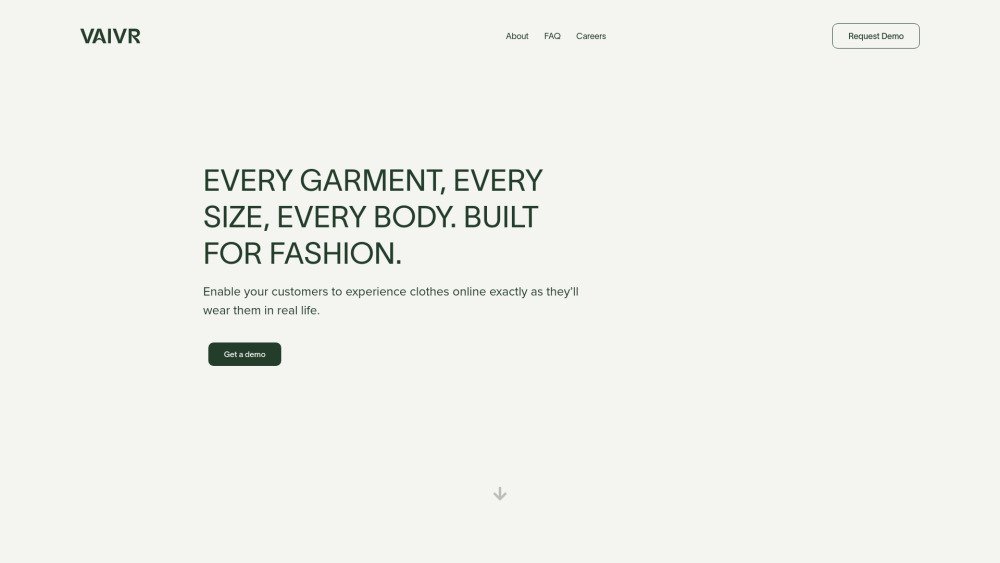
VAIVR offers virtual fitting technology that allows online shoppers to see how clothes will look, move, and fit on their body through real-time 3D video. It provides personalized try-on experiences to build shopping confidence, reduce returns, and transform retail.
Customers can preview how clothes will look by uploading a photo and selecting a garment. VAIVR's technology then generates a dynamic video preview of the item.
Implementation is fast and straightforward. Our Shopify-style app integrates easily with your existing e-commerce platform. Most brands can go live within weeks without requiring complex technical integration.
Simply connect your store, provide your size data, and choose the products you wish to enable. We manage the technical process of creating and optimizing the experience.
We aim for a 20-30% reduction in size-related returns. By allowing shoppers to see how garments look and move on their bodies, we increase purchase confidence and discourage 'buy-to-try' behavior.
Unlike basic virtual try-on solutions, VAIVR provides a consistent experience that functions identically online and in-store. We display realistic movement and fit rather than static visualizations.
Free plan available.
Use these comparison pages to understand the trade-offs between the models most relevant to VAIVR.
Compare Gemini 1.0 Pro Deprecated and Gemini 2.0 Flash across pricing, context window, capabilities, benchmarks, and API access to choose the better fit for long-context workloads versus long-context workloads.
Compare Gemini 1.0 Pro Deprecated and Gemini 2.5 Flash across pricing, context window, capabilities, benchmarks, and API access to choose the better fit for long-context workloads versus long-context workloads.
Compare Gemini 2.0 Flash Lite and Gemini 2.0 Flash across pricing, context window, capabilities, benchmarks, and API access to choose the better fit for long-context workloads versus long-context workloads.
Compare Gemini 2.5 Flash and Gemini 2.0 Flash across pricing, context window, capabilities, benchmarks, and API access to choose the better fit for long-context workloads versus long-context workloads.