
Free
$0Free plan available.
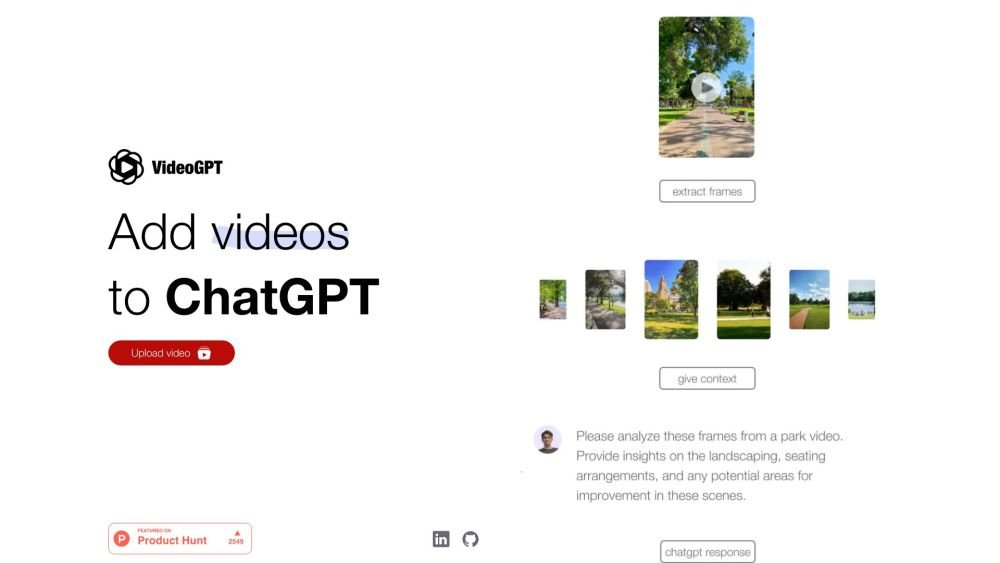
Video GPT allows users to effortlessly capture still frames from any video for ChatGPT-4V. It enhances conversations with vivid visuals, unlocking a new level of engagement. It is optimized for images, and lets your creativity soar!
Upload a video to Video GPT and extract the desired still frames. You can then use these images within your ChatGPT-4V conversations to provide visual context.
Video GPT allows you to capture still frames from any video to use in ChatGPT-4V, which helps add visual context to your conversations.
Free plan available.
Use these comparison pages to understand the trade-offs between the models most relevant to Video GPT.
Compare GPT 5.4 and GPT 5.4 Pro across pricing, context window, capabilities, benchmarks, and API access to choose the better fit for long-context workloads versus long-context workloads.
Compare GPT 5.5 and GPT 5.4 across pricing, context window, capabilities, benchmarks, and API access to choose the better fit for long-context workloads versus long-context workloads.
Compare GPT 5.5 and Claude 4.6 Opus across pricing, context window, capabilities, benchmarks, and API access to choose the better fit for long-context workloads versus long-context workloads.
Compare GPT 5.5 and Claude 4.6 Sonnet across pricing, context window, capabilities, benchmarks, and API access to choose the better fit for long-context workloads versus long-context workloads.

Similar AI tool in the AI Assistant category.
Similar AI tool in the AI Assistant category.
Similar AI tool in the AI Productivity Tools category.
Similar AI tool in the AI Assistant category.
Similar AI tool in the AI Assistant category.
Similar AI tool in the AI Assistant category.
Similar AI tool in the AI Chatbot category.
Similar AI tool in the AI Chatbot category.
Similar AI tool in the AI Productivity Tools category.
Similar AI tool in the AI Assistant category.
Similar AI tool in the AI Assistant category.
Similar AI tool in the AI Assistant category.