
Free
$0Free plan available.
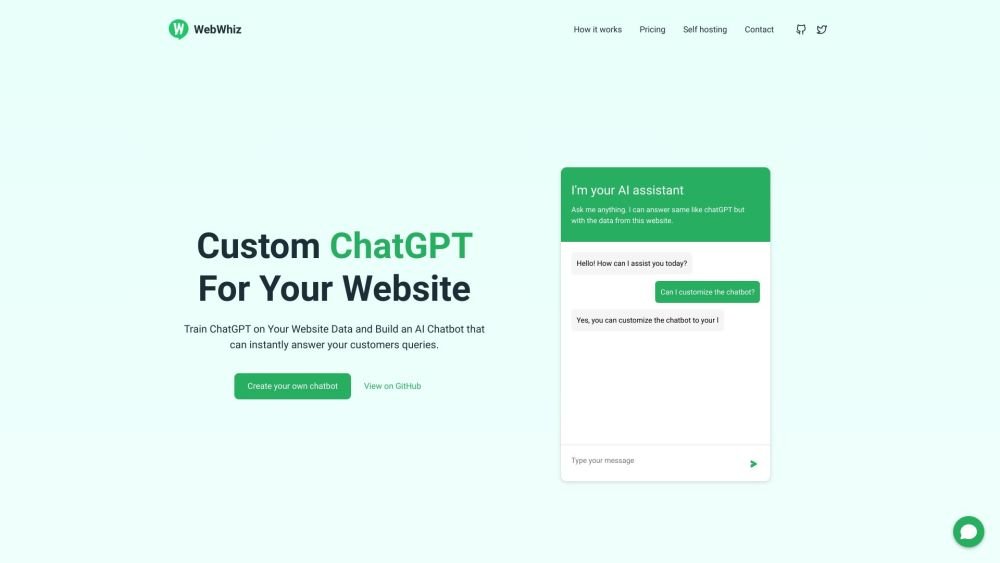
WebWhiz allows you to create an AI chatbot that knows everything about your product and can instantly respond to your customer's queries. It's a ChatGPT for your website, enabling you to launch an AI-powered assistant that delivers instant, precise responses to support queries. WebWhiz provides data-specific responses, ensuring accuracy, and offers regular data updates by crawling your website. It supports 100+ languages and prioritizes GDPR compliance.
First, add your website URL to WebWhiz. The system will then automatically fetch and prepare the necessary training data. Next, WebWhiz trains ChatGPT on your website content to create a custom chatbot. Finally, embed the chatbot on your site by adding a small script tag.
WebWhiz allows you to train ChatGPT on your website data and build a chatbot that you can add to your website without any coding required.
Currently, we crawl your website once every month. Please contact us if you require more frequent scanning.
WebWhiz collects text data and metadata, such as page titles or descriptions, from your website to train your chatbot. We do not collect personally identifiable information (PII) or sensitive data, as we only scan public information available to search engines.
We will notify you if you exceed your plan's limits for projects or pages. If you exceed your plan's token limit, your chatbots will stop generating AI responses and will instead provide a predefined message.
Tokens are units of measurement used to calculate the amount of text data processed by your chatbot. Each message sent by the chatbot consumes a specific number of tokens based on the length and complexity of the input and the AI response. You can monitor your account's current token usage via the dashboard.
Yes, you can train the chatbot on custom data by pasting your content directly into WebWhiz.
Yes, you can use your own API key.
WebWhiz does not have specific limitations on the size of the context. However, the number of pages you can crawl is determined by your chosen plan. Please refer to our plans page for details on specific limitations.
Free plan available.
Use these comparison pages to understand the trade-offs between the models most relevant to WebWhiz.
Compare GPT 5.4 and GPT 5.4 Pro across pricing, context window, capabilities, benchmarks, and API access to choose the better fit for long-context workloads versus long-context workloads.
Compare GPT 5.5 and GPT 5.4 across pricing, context window, capabilities, benchmarks, and API access to choose the better fit for long-context workloads versus long-context workloads.
Compare GPT 5.5 and Claude 4.6 Opus across pricing, context window, capabilities, benchmarks, and API access to choose the better fit for long-context workloads versus long-context workloads.
Compare GPT 5.5 and Claude 4.6 Sonnet across pricing, context window, capabilities, benchmarks, and API access to choose the better fit for long-context workloads versus long-context workloads.

Similar AI tool in the AI Assistant category.
Similar AI tool in the AI Assistant category.
Similar AI tool in the AI Assistant category.
Similar AI tool in the AI Productivity Tools category.
Similar AI tool in the AI Assistant category.
Similar AI tool in the AI Assistant category.
Similar AI tool in the AI Chatbot category.
Similar AI tool in the AI Chatbot category.
Similar AI tool in the AI Assistant category.
Similar AI tool in the AI Chatbot category.
Similar AI tool in the AI Assistant category.
Similar AI tool in the AI Assistant category.