Arvin AI

0
5 0 Reviews 0 Saved
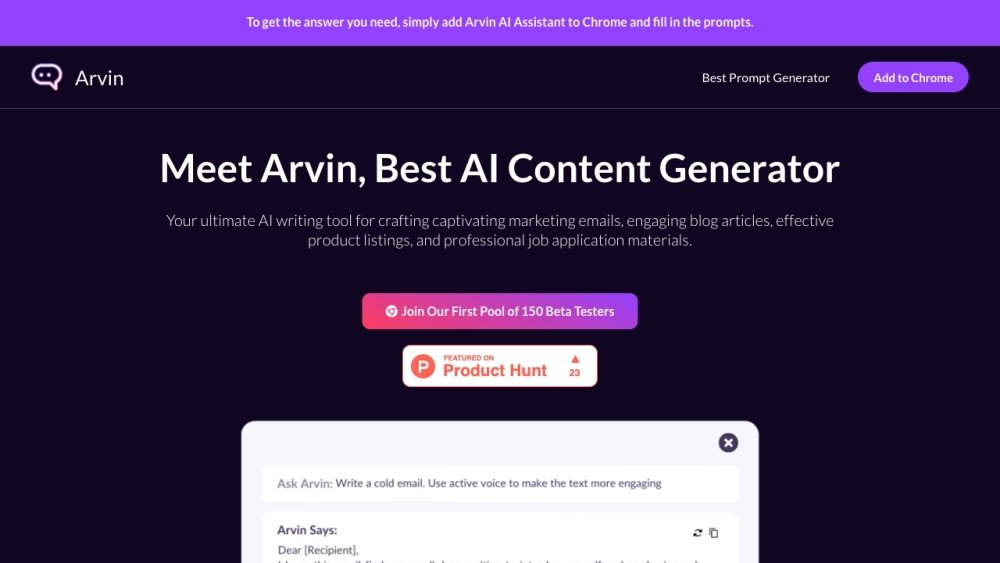
Introduction: Arvin AI: Arvin AI is an all-in-one AI assistant powered by GPT-4o, Gemini 1.5, and Flux. It offers a range of tools including an AI resume and cover letter writer, AI writing tools for marketing emails and blog articles, product listings, and job application materials. It also provides AI art generation, summaries, and content creation through a Chrome extension. Arvin AI includes features for AI chat, search, data analysis, and various writing, image, and reading tools.

Arvin AI Product Information

What is Arvin AI?

Arvin AI is your browsing copilot. It integrates powerful AI models (like GPT-4 and Claude) directly into your browser side-panel. You can use it to summarize the article you're reading, write a reply to an email in Gmail, or generate social media posts on Twitter/X without ever leaving the tab. It works as a universal overlay for productivity.

How to use Arvin AI?

1. **Install Extension**: Add Arvin to Chrome or Edge.
2. **Activate**: Press Alt+A or click the icon on any page.
3. **Interact**: Ask it to summarize the page, write text, or answer questions.

Arvin AI Use Cases

#1 "[\"Summarizing long YouTube videos and articles\",\"Writing and replying to emails 10x faster\",\"Translating selected text on foreign websites instantly\"]"

Related Model Comparison Pages

Use these comparison pages to understand the trade-offs between the models most relevant to Arvin AI.

Compare Gemini 1.0 Pro Deprecated and Gemini 2.0 Flash across pricing, context window, capabilities, benchmarks, and API access to choose the better fit for long-context workloads versus long-context workloads.

Compare Gemini 1.0 Pro Deprecated and Gemini 1.5 Flash Deprecated across pricing, context window, capabilities, benchmarks, and API access to choose the better fit for long-context workloads versus general-purpose AI workloads.

Compare Gemini 1.0 Pro Deprecated and Gemini 2.5 Flash across pricing, context window, capabilities, benchmarks, and API access to choose the better fit for long-context workloads versus long-context workloads.