
Free
$0Free plan available.
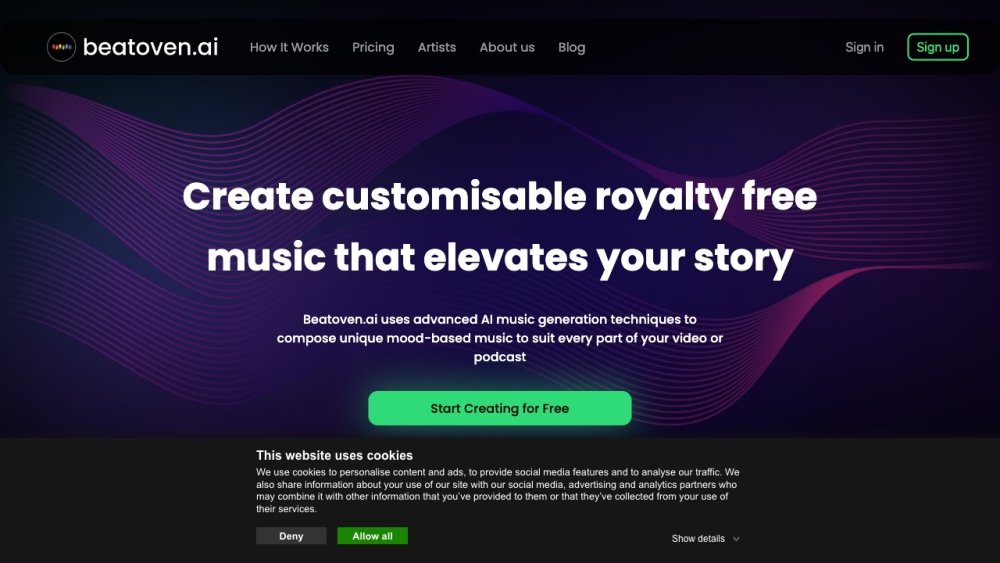
Beatoven.ai uses advanced AI music generation techniques to compose unique, mood-based music that fits specific sections of your video or podcast. It serves as a royalty-free AI music generator, allowing users to create background music for videos, podcasts, and games. The platform uses cookies to personalize content and analyze traffic.
Users can input an idea for their desired music, click “Compose Track,” and generate unique background music. The platform allows for further refinement using prompt-based customization features, followed by the ability to download stems in MP3 or WAV formats. A license granting content monetization rights is delivered directly to your inbox with every download.
You can use the AI music generator to create tracks for video content (YouTube), podcasts, games, short films, trailers, AI art, social media, audiobooks, advertisements, and livestreams. Beatoven.ai supports all your background music needs across these platforms.
You receive a non-exclusive, perpetual license for any track you generate and download. This license grants you the rights to use the music in your video or audio content—such as podcasts, talk shows, or audiobooks—and monetize that content without concern. However, Beatoven.ai retains ownership of the tracks generated and downloaded from the platform.
Generally, you should not receive a copyright claim for music created with Beatoven.ai. In the unlikely event that you do receive a claim on YouTube, report it using the track ID provided in your license. Additionally, complete our support form so we can resolve the issue for you.
No. We do not permit the direct distribution of music created with Beatoven.ai on music streaming platforms like Spotify or Apple Music. However, you may use Beatoven's stems for sampling purposes in your own remixes.
Free plan available.
Use these comparison pages to understand the trade-offs between the models most relevant to Beatoven.ai.
Compare Gemini 1.0 Pro Deprecated and Gemini 2.0 Flash across pricing, context window, capabilities, benchmarks, and API access to choose the better fit for long-context workloads versus long-context workloads.
Compare Gemini 1.0 Pro Deprecated and Gemini 2.5 Flash across pricing, context window, capabilities, benchmarks, and API access to choose the better fit for long-context workloads versus long-context workloads.
Compare Gemini 2.0 Flash Lite and Gemini 2.0 Flash across pricing, context window, capabilities, benchmarks, and API access to choose the better fit for long-context workloads versus long-context workloads.
Compare Gemini 2.5 Flash and Gemini 2.0 Flash across pricing, context window, capabilities, benchmarks, and API access to choose the better fit for long-context workloads versus long-context workloads.

Similar AI tool in the AI Assistant category.
Similar AI tool in the AI Writing Assistants category.
Similar AI tool in the AI Image Generator category.
Similar AI tool in the AI Writing Assistants category.
Similar AI tool in the AI Writing Assistants category.
Similar AI tool in the AI Text-to-Speech category.
Similar AI tool in the AI Chatbot category.
Similar AI tool in the AI API category.
Similar AI tool in the AI Image Generator category.
Similar AI tool in the AI Music Generator category.
Similar AI tool in the AI Assistant category.
Similar AI tool in the AI Video Generator category.