Brain.fm

12
5 0 Reviews 12 Saved
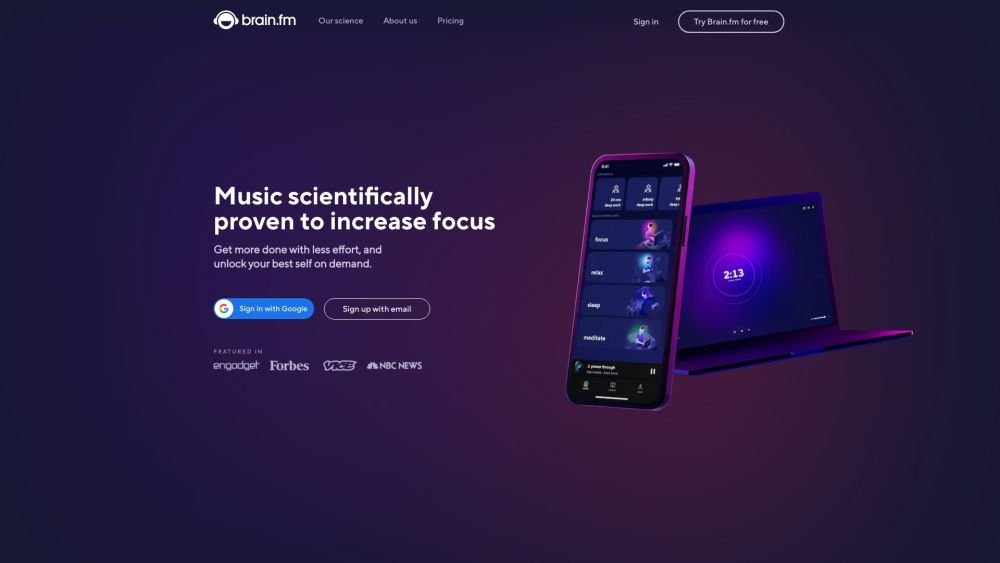
Introduction: Brain.fm: Brain.fm is a science-backed functional music platform designed to enhance focus, relaxation, and sleep. It uses AI-composed music with gentle rhythmic pulses to stimulate the brain and support sustained attention. Brain.fm's music is engineered to optimize performance by affecting brainwaves and promoting synchronization, unlike regular music that can be distracting.
Monthly Visitors: 3.7M

Brain.fm Product Information

What is Brain.fm?

Brain.fm uses AI-generated music to influence your cognitive state. Unlike regular music, its tracks are engineered with specific rhythmic pulses that stimulate the brain to enter states of deep focus, relaxation, or sleep. Backed by academic research, it is a tool for productivity hacking and mental wellness.

How to use Brain.fm?

Select your goal (Focus, Relax, Sleep) and duration. The app plays a continuous, non-distracting stream of functional music.

Brain.fm's Core Features

  • "[\"AI-composed functional music\",\"Scientifically proven to increase focus\",\"Customizable neural effect levels\",\"Music for focus, relaxation, and sleep\",\"Offline access\"]"

Brain.fm Use Cases

#1 null

Related Model Comparison Pages

Use these comparison pages to understand the trade-offs between the models most relevant to Brain.fm.

Compare Gemini 1.0 Pro Deprecated and Gemini 2.0 Flash across pricing, context window, capabilities, benchmarks, and API access to choose the better fit for long-context workloads versus long-context workloads.

Compare Gemini 1.0 Pro Deprecated and Gemini 2.5 Flash across pricing, context window, capabilities, benchmarks, and API access to choose the better fit for long-context workloads versus long-context workloads.

Compare Gemini 2.0 Flash Lite and Gemini 2.0 Flash across pricing, context window, capabilities, benchmarks, and API access to choose the better fit for long-context workloads versus long-context workloads.

Compare Gemini 2.5 Flash and Gemini 2.0 Flash across pricing, context window, capabilities, benchmarks, and API access to choose the better fit for long-context workloads versus long-context workloads.