
Free
$0Free plan available.
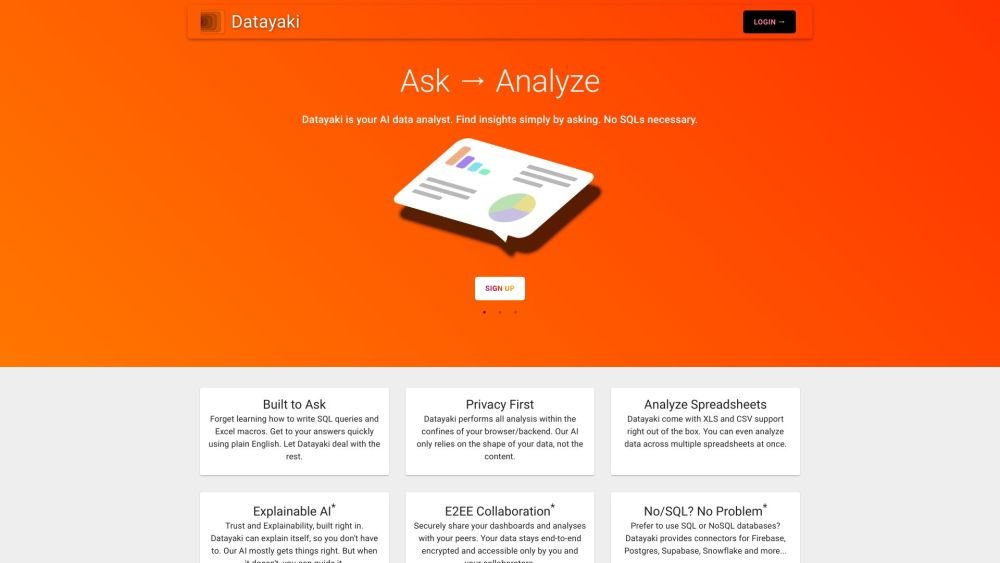
Datayaki is an AI-powered data analyst that enables you to uncover insights and build dashboards by simply asking questions. It is a data analytics tool designed to generate widgets through natural language queries.
Simply ask Datayaki to generate insights and build dashboards. The platform allows you to create widgets by asking questions.
Datayaki is an AI-powered data analyst that helps you uncover insights and build dashboards quickly by simply asking questions.
You can generate widgets and discover insights by simply asking questions.
Free plan available.
Use these comparison pages to understand the trade-offs between the models most relevant to Datayaki.
Compare Amazon Nova Pro and Amazon Nova Lite across pricing, context window, capabilities, benchmarks, and API access to choose the better fit for tool-augmented workflows versus tool-augmented workflows.
Compare Amazon Nova Lite and Amazon Nova Micro across pricing, context window, capabilities, benchmarks, and API access to choose the better fit for tool-augmented workflows versus tool-augmented workflows.
Compare Amazon Nova Lite and Mistral Medium 3 across pricing, context window, capabilities, benchmarks, and API access to choose the better fit for tool-augmented workflows versus tool-augmented workflows.
Compare Amazon Nova Lite and Mistral Small 3.1 (25.03) across pricing, context window, capabilities, benchmarks, and API access to choose the better fit for tool-augmented workflows versus cost-efficient scale.

Similar AI tool in the AI Assistant category.
Similar AI tool in the AI Assistant category.
Similar AI tool in the AI Assistant category.
Similar AI tool in the AI Assistant category.
Similar AI tool in the AI Chatbot category.
Similar AI tool in the AI Chatbot category.
Similar AI tool in the AI Chatbot category.
Similar AI tool in the AI Assistant category.
Similar AI tool in the AI Assistant category.
Similar AI tool in the AI Assistant category.
Similar AI tool in the AI Summarizer category.
Similar AI tool in the AI Summarizer category.