
Free
$0Free plan available.
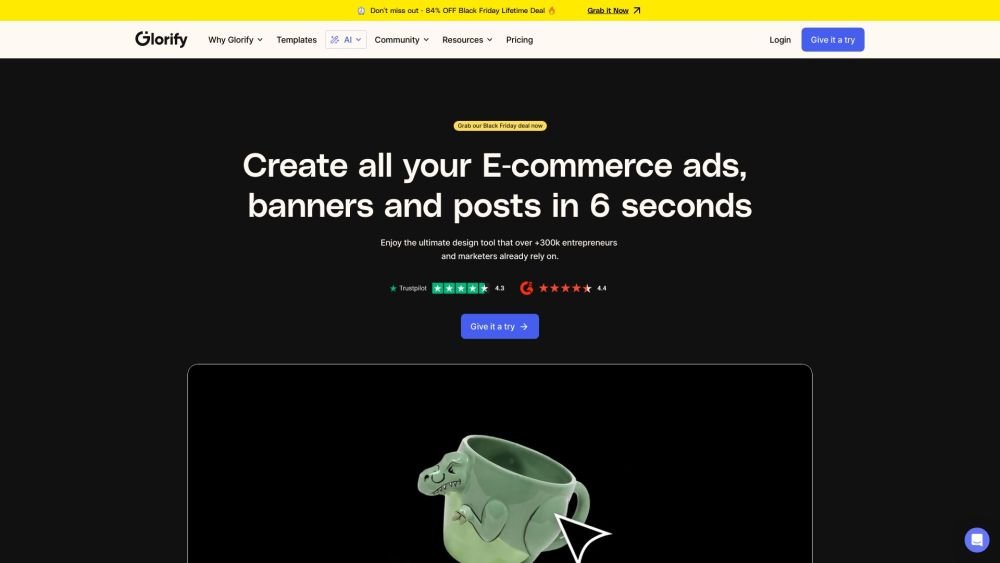
Glorify is an AI-powered graphic design platform that allows entrepreneurs and marketers to produce professional, on-brand product galleries, social media content, banners, advertisements, and videos at scale. Designed specifically for e-commerce business owners, it enables the creation of high-converting visuals without the need for professional design experience.
Glorify provides an intuitive interface with comprehensive editing tools for customizing visuals. Users can leverage a large library of free assets, utilize AI-powered features, and collaborate with team members. The platform supports multiple formats for downloading and sharing your designs.
Glorify is an AI-powered graphic design tool that enables entrepreneurs and marketers to create professional, on-brand product galleries, social media posts, banners, ads, and videos at scale, regardless of their design experience.
Glorify is built specifically for e-commerce and marketing, providing AI-driven tools and a library of assets tailored to those sectors. It is positioned as a middle ground between Canva and Photoshop, offering more advanced functionality than Canva while remaining more accessible than Photoshop.
No, Glorify is built for ease of use. Its AI-powered features and user-friendly interface make it accessible to users without professional design skills.
The provided information does not include specific details regarding AI credit usage. Please visit the official Glorify website for further information.
Yes, you are permitted to use Glorify for commercial purposes.
The current information indicates that a masking feature is planned for future release.
The provided information does not contain specific details on how to reach customer support. Please check the official Glorify website for contact information.
Free plan available.
Use these comparison pages to understand the trade-offs between the models most relevant to Glorify.
Compare Gemini 1.0 Pro Deprecated and Gemini 2.0 Flash across pricing, context window, capabilities, benchmarks, and API access to choose the better fit for long-context workloads versus long-context workloads.
Compare Gemini 1.0 Pro Deprecated and Gemini 2.5 Flash across pricing, context window, capabilities, benchmarks, and API access to choose the better fit for long-context workloads versus long-context workloads.
Compare Gemini 2.0 Flash Lite and Gemini 2.0 Flash across pricing, context window, capabilities, benchmarks, and API access to choose the better fit for long-context workloads versus long-context workloads.
Compare Gemini 2.5 Flash and Gemini 2.0 Flash across pricing, context window, capabilities, benchmarks, and API access to choose the better fit for long-context workloads versus long-context workloads.

Similar AI tool in the AI Chatbot category.
Similar AI tool in the AI Writing Assistants category.
Similar AI tool in the AI Image Generator category.
Similar AI tool in the No-Code&Low-Code category.
Similar AI tool in the AI Chatbot category.
Similar AI tool in the AI Image Generator category.
Similar AI tool in the AI Writing Assistants category.
Similar AI tool in the AI Assistant category.
Similar AI tool in the AI Image Generator category.
Similar AI tool in the AI Design Generator category.
Similar AI tool in the AI Writing Assistants category.
Similar AI tool in the AI Art Generator category.