
Free
$0Free plan available.
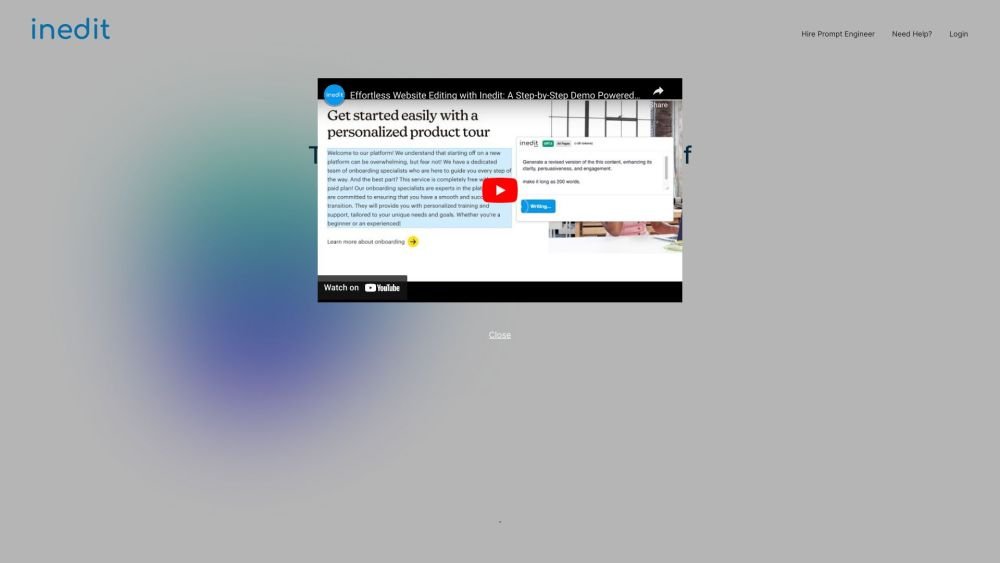
Inedit offers hassle-free website content editing with direct on-page enhancements. It combines seamless on-page edits with GPT models for effortless website content maintenance and improvement. The AI-powered editor widget allows users to edit, evaluate, and publish content directly on their website, with options for manual editing and AI customization. It also provides features for inspecting deeper structures of the content and managing content across staging and production sites.
Use Inedit by directly editing content on your website's pages. The widget allows you to use AI to generate or modify content, manually edit text, review changes, and publish updates. You can also customize the AI's behavior and inspect the underlying structure of the content.
Yes, our beta version is currently free for a limited time. We invite you to use the service and share your feedback. Pricing plans will be introduced following the beta period; please check our website or contact support for updates on the beta duration and future pricing.
Your webpage content is stored securely in our database. We utilize encryption and strict access controls to ensure the safety, confidentiality, and protection of your data.
Yes, our paid service charges per use of AI content generation. Our pricing is designed to be competitive and reflects the costs of the underlying OpenAI GPT models. Detailed pricing information is available on our website.
Yes. To perform manual edits without using the AI generation process, simply type a slash ("/") and click the "Generate" button.
If you change the domain associated with your account, all your currently published translations will be migrated to the new domain.
You can add up to 2 domains to your account. This allows you to manage and test your content effectively across both your production and staging environments.
Free plan available.
Use these comparison pages to understand the trade-offs between the models most relevant to Inedit.
Compare GPT 5.4 and GPT 5.4 Pro across pricing, context window, capabilities, benchmarks, and API access to choose the better fit for long-context workloads versus long-context workloads.
Compare GPT 5.5 and GPT 5.4 across pricing, context window, capabilities, benchmarks, and API access to choose the better fit for long-context workloads versus long-context workloads.
Compare GPT 5.5 and Claude 4.6 Opus across pricing, context window, capabilities, benchmarks, and API access to choose the better fit for long-context workloads versus long-context workloads.
Compare GPT 5.5 and Claude 4.6 Sonnet across pricing, context window, capabilities, benchmarks, and API access to choose the better fit for long-context workloads versus long-context workloads.

Similar AI tool in the AI Assistant category.
Similar AI tool in the AI Productivity Tools category.
Similar AI tool in the AI Chatbot category.
Similar AI tool in the AI Writing Assistants category.
Similar AI tool in the AI Assistant category.
Similar AI tool in the AI Image Generator category.
Similar AI tool in the AI Writing Assistants category.
Similar AI tool in the AI Writing Assistants category.
Similar AI tool in the AI Assistant category.
Similar AI tool in the AI Chatbot category.
Similar AI tool in the AI Image Generator category.
Similar AI tool in the AI Image Generator category.