
Free
$0Free plan available.
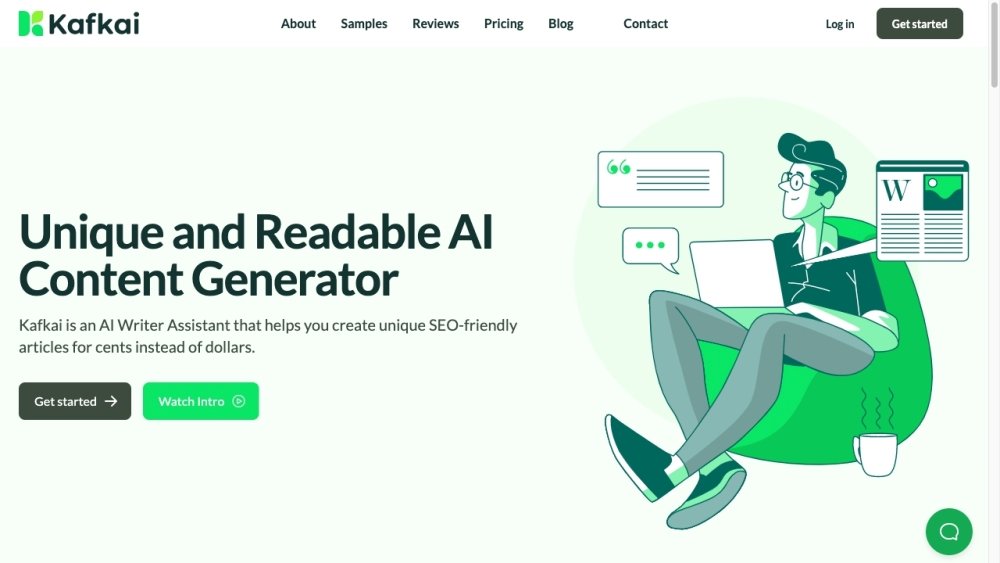
Kafkai is a machine-learning algorithm that can write articles from scratch. It's an AI SEO Content & Competitor Insights Tool designed to create SEO-optimized content and analyze competitors. Perfect for small businesses and marketers, Kafkai saves hours of research time and improves search visibility. It leverages advanced keyword analysis and competitor insights to deliver proven SEO strategies that drive higher rankings and streamline content creation.
To use Kafkai, start by creating a project and adding your website along with at least one competitor. Next, select a strategy mode (Catch Up, Compete, Consolidate, or Complement). Then, refine the suggested keywords, titles, and outline. Finally, generate the article and customize it to incorporate your own E-E-A-T (Expertise, Authoritativeness, Trustworthiness).
Kafkai is an AI-powered tool that assists in creating SEO-focused content through advanced keyword analysis and competitor insights. By automating SEO research, Kafkai provides strategies and content designed to improve your search rankings.
Please refer to our pricing page for details.
Step 1: Create your project by adding your website and at least one competitor. Step 2: Choose a strategy from the 4Cs (Catch Up, Compete, Consolidate, Complement) to determine your content focus. Step 3: Customize the suggested keywords, titles, and outline provided by Kafkai. Step 4: Generate the article with one click, then refine it to add your own E-E-A-T.
No, you do not need technical SEO expertise. While basic terminology helps, you can begin using the tool without prior knowledge.
Kafkai integrates SEO data directly into the content generation process. While other tools may require you to manually research and direct the content, Kafkai handles both the research and generation in one workflow, requiring only that you identify your competitors.
Yes, you can create a trial project with limited resources, including a restricted number of keywords and competitors. You may generate up to 3 articles during your trial. A full subscription is required to access all features for new projects.
Free plan available.
Use these comparison pages to understand the trade-offs between the models most relevant to Kafkai.
Compare Amazon Nova Pro and Amazon Nova Lite across pricing, context window, capabilities, benchmarks, and API access to choose the better fit for tool-augmented workflows versus tool-augmented workflows.
Compare Amazon Nova Lite and Amazon Nova Micro across pricing, context window, capabilities, benchmarks, and API access to choose the better fit for tool-augmented workflows versus tool-augmented workflows.
Compare Amazon Nova Lite and Mistral Medium 3 across pricing, context window, capabilities, benchmarks, and API access to choose the better fit for tool-augmented workflows versus tool-augmented workflows.
Compare Amazon Nova Lite and Mistral Small 3.1 (25.03) across pricing, context window, capabilities, benchmarks, and API access to choose the better fit for tool-augmented workflows versus cost-efficient scale.

Similar AI tool in the AI Assistant category.
Similar AI tool in the AI Productivity Tools category.
Similar AI tool in the AI Writing Assistants category.
Similar AI tool in the AI Image Generator category.
Similar AI tool in the AI Assistant category.
Similar AI tool in the AI Assistant category.
Similar AI tool in the AI Writing Assistants category.
Similar AI tool in the AI Writing Assistants category.
Similar AI tool in the AI Assistant category.
Similar AI tool in the AI Chatbot category.
Similar AI tool in the AI Chatbot category.
Similar AI tool in the AI Writing Assistants category.