
Free
$0Free plan available.
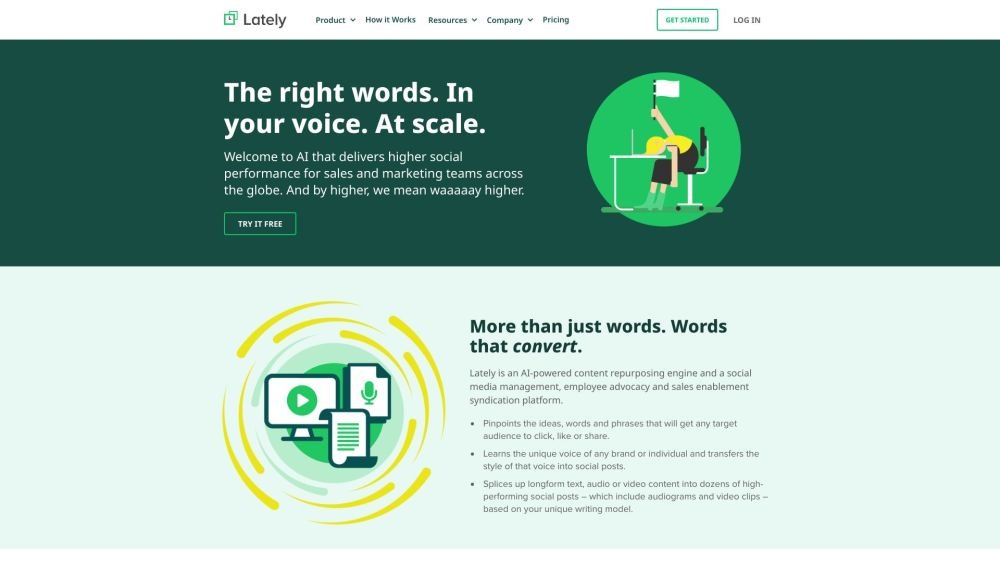
Lately AI is an AI-powered content creation assistant that repurposes long-form content into social media posts. It uses AI and neuroscience to learn a brand's specific dialect and nuances, turning existing content into social media assets. It helps users schedule and automate social media content to save time and increase engagement.
Users provide Lately AI with their long-form content, such as text, audio, or video. The AI then generates dozens of social media posts tailored for specific platforms and target audiences. Finally, users can schedule these posts for optimal timing and cadence.
Lately AI can process any form of long-form content, including text, audio, and video. This encompasses earned, owned, or found media, such as podcasts, webinars, blogs, and more.
Yes. Lately AI generates social posts from text, video, and audio. From text, it creates dozens of social posts. From audio, it produces a transcript and multiple social posts with matching audiograms. From video, it generates a transcript and multiple posts with corresponding video clips.
Yes. You can schedule and publish directly from any Startly plan to Twitter, Facebook, Instagram, or LinkedIn. The Litely and Professionally plans allow scheduling and publishing to all four of these platforms. Scheduling and publishing to YouTube is exclusively available on the Enterprisely plan.
Lately integrates with Hootsuite, Hootsuite Amplify, and HubSpot Marketing Hub, allowing you to publish AI-generated content directly from those platforms. Additional integration partners are expected in the future.
Yes. You can syndicate AI-generated content to an unlimited number of employee or brand accounts through the Enterprisely plan.
Free plan available.
Use these comparison pages to understand the trade-offs between the models most relevant to Lately AI.
Compare Gemini 1.0 Pro Deprecated and Gemini 2.0 Flash across pricing, context window, capabilities, benchmarks, and API access to choose the better fit for long-context workloads versus long-context workloads.
Compare Gemini 1.0 Pro Deprecated and Gemini 2.5 Flash across pricing, context window, capabilities, benchmarks, and API access to choose the better fit for long-context workloads versus long-context workloads.
Compare Gemini 2.0 Flash Lite and Gemini 2.0 Flash across pricing, context window, capabilities, benchmarks, and API access to choose the better fit for long-context workloads versus long-context workloads.
Compare Gemini 2.5 Flash and Gemini 2.0 Flash across pricing, context window, capabilities, benchmarks, and API access to choose the better fit for long-context workloads versus long-context workloads.

Similar AI tool in the AI Social Media category.
Similar AI tool in the AI Social Media category.
Similar AI tool in the AI Chatbot category.
Similar AI tool in the AI Assistant category.
Similar AI tool in the AI Assistant category.
Similar AI tool in the AI Assistant category.
Similar AI tool in the AI API category.
Similar AI tool in the AI Assistant category.
Similar AI tool in the AI Assistant category.
Similar AI tool in the AI Assistant category.
Similar AI tool in the AI Chatbot category.
Similar AI tool in the AI Productivity Tools category.