
Free
$0Free plan available.
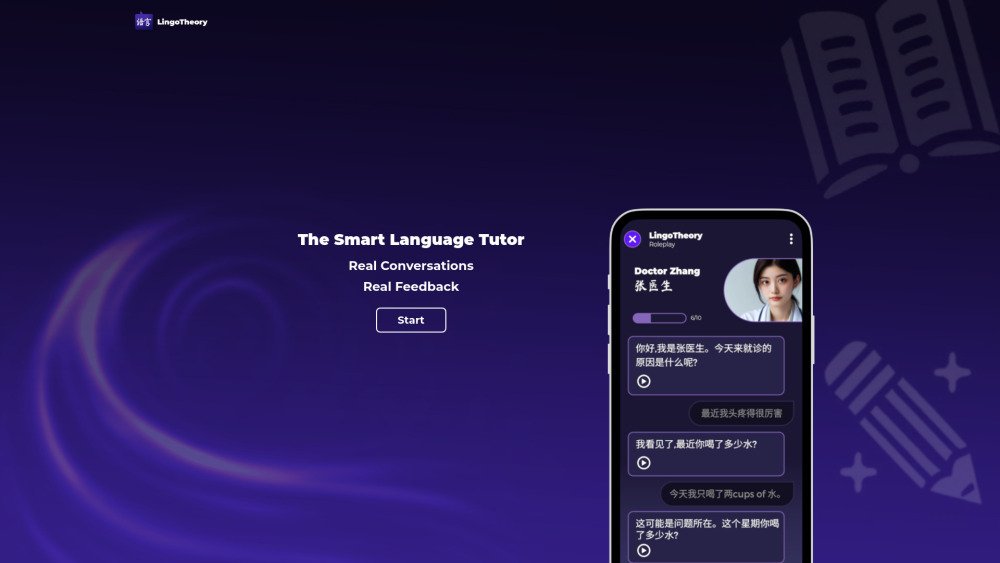
LingoTheory Ai is an AI language learning platform designed to help users practice speaking Mandarin Chinese through daily conversations with a smart AI tutor. It utilizes flashcards and generative AI conversations to improve speaking and listening skills. The platform focuses on real-world scenarios to enhance comprehension and enable users to have natural conversations with native speakers. It also provides instant feedback on mistakes and tracks progress to build daily learning habits.
Users can select from various scenarios and characters, listen to audio or read text, and respond naturally. The AI tutor can explain vocabulary in English and understands both English and Chinese, even when used in the same sentence. Users can repeat conversations to refine their skills and provide feedback to the AI regarding its language usage.
The web version of LingoTheory is free to use.
Yes, you can respond using English and start by listening or asking the AI to explain words you do not understand.
Yes. Press the microphone icon to record your voice and the 'stop recording' button to finish. Your speech is converted to text using an advanced AI model.
Currently, only Simplified Mandarin Chinese is supported.
The AI demonstrates a high level of language proficiency and responds naturally, similar to a native speaker. The error rate regarding grammar, pronunciation, and vocabulary is very low.
You can toggle pinyin on or off using the menu located in the upper right corner.
If you are comfortable with your child using tools like ChatGPT, this platform carries a similar risk profile, as it utilizes the same service providers (OpenAI, Microsoft, Google, etc.).
Yes and no. The initial language tool, which combines flashcards and AI, is available on Android under the name 'LingoTheory.' The web version of LingoTheory builds on that foundation to offer more engaging, scenario-based conversations.
Free plan available.
Use these comparison pages to understand the trade-offs between the models most relevant to LingoTheory Ai.
Compare GPT 5.4 and GPT 5.4 Pro across pricing, context window, capabilities, benchmarks, and API access to choose the better fit for long-context workloads versus long-context workloads.
Compare GPT 5.5 and GPT 5.4 across pricing, context window, capabilities, benchmarks, and API access to choose the better fit for long-context workloads versus long-context workloads.
Compare GPT 5.5 and Claude 4.6 Opus across pricing, context window, capabilities, benchmarks, and API access to choose the better fit for long-context workloads versus long-context workloads.
Compare GPT 5.5 and Claude 4.6 Sonnet across pricing, context window, capabilities, benchmarks, and API access to choose the better fit for long-context workloads versus long-context workloads.

Similar AI tool in the AI Assistant category.
Similar AI tool in the AI Assistant category.
Similar AI tool in the AI Assistant category.
Similar AI tool in the AI Productivity Tools category.
Similar AI tool in the AI Assistant category.
Similar AI tool in the AI Chatbot category.
Similar AI tool in the AI Chatbot category.
Similar AI tool in the AI Assistant category.
Similar AI tool in the AI Chatbot category.
Similar AI tool in the AI Chatbot category.
Similar AI tool in the Large Language Models (LLMs) category.
Similar AI tool in the AI Assistant category.