
Free
$0Free plan available.
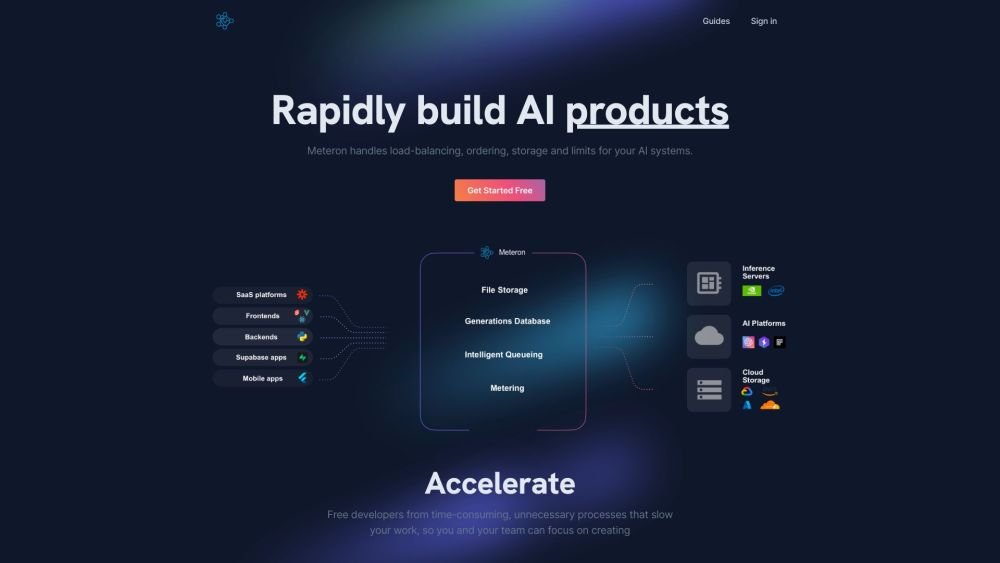
Meteron is a backend platform designed to help users build AI products seamlessly. It simplifies infrastructure autoscaling and storage complexities. Meteron handles LLM and generative AI metering, load-balancing, and storage, freeing developers from time-consuming processes. It offers tools and resources to grow an AI business, allowing users to serve better models and get more traffic without needing to be an AI platform pro.
To use Meteron, integrate your AI models and applications with Meteron's API. Meteron manages metering, load balancing, and storage. You can manage your servers via the web UI or a dynamic API. Additionally, Meteron provides documentation examples and a Discord server for support.
No, you can use any standard HTTP client such as curl, Python requests, or JavaScript fetch libraries. Simply route your requests to the Meteron generation API instead of your direct inference endpoint.
You can register your servers via the web UI if they are static or infrequently updated. For dynamic environments, we provide a simple API to update your server information.
Meteron includes standard business rules for queue management. You can assign a priority class (high, medium, or low) to each request; high-priority requests for VIP users are processed without queuing delays.
Meteron is a low-code service that requires basic knowledge of HTTP. We provide integration examples to assist you, and our Discord server is available if you need further support.
Yes, on-premise licenses are available. This provides a complete system that you can deploy on any cloud provider. Please contact us at hey@meteron.ai for more information.
We accept all major credit cards and direct wire transfers.
When configuring model endpoints (clusters) in Meteron, you can set daily and monthly usage limits. By including the X-User header with a user ID or email in your generation requests, Meteron will automatically enforce these limits for each user.
Free plan available.
Use these comparison pages to understand the trade-offs between the models most relevant to Meteron AI.
Compare Amazon Nova Lite and Mistral Medium 3 across pricing, context window, capabilities, benchmarks, and API access to choose the better fit for tool-augmented workflows versus tool-augmented workflows.
Compare Amazon Nova Pro and Mistral Medium 3 across pricing, context window, capabilities, benchmarks, and API access to choose the better fit for tool-augmented workflows versus tool-augmented workflows.
Compare DeepSeek V4 Flash and Mistral Medium 3 across pricing, context window, capabilities, benchmarks, and API access to choose the better fit for long-context workloads versus tool-augmented workflows.
Compare DeepSeek V4 Pro and Mistral Medium 3 across pricing, context window, capabilities, benchmarks, and API access to choose the better fit for long-context workloads versus tool-augmented workflows.

Similar AI tool in the AI Assistant category.
Similar AI tool in the AI Assistant category.
Similar AI tool in the AI Productivity Tools category.
Similar AI tool in the AI Chatbot category.
Similar AI tool in the AI Writing Assistants category.
Similar AI tool in the AI Image Generator category.
Similar AI tool in the AI Writing Assistants category.
Similar AI tool in the AI Writing Assistants category.
Similar AI tool in the AI Assistant category.
Similar AI tool in the AI Image Generator category.
Similar AI tool in the AI Chatbot category.
Similar AI tool in the AI Image Generator category.