
Free
$0Free plan available.
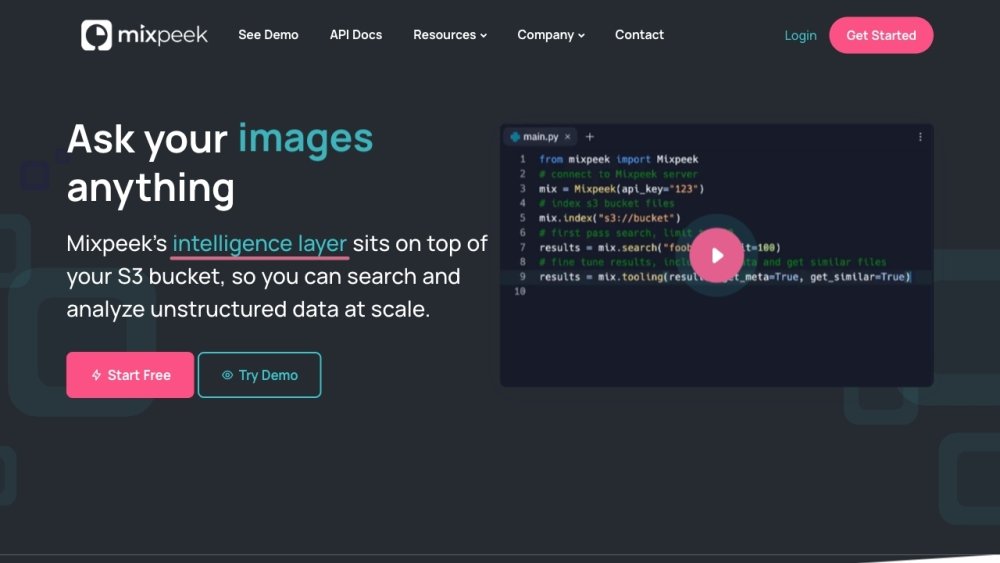
Mixpeek is an intelligence layer for object stores like S3 that uses NLP to interpret non-text files via a GET /search API call. Designed as a multimodal data warehouse for developers, it processes and extracts features from text, images, video, audio, and PDFs at scale. It provides a unified API to extract insights, identify patterns, and query across diverse media types through a single interface.
To use Mixpeek, begin by setting it up with a single line of code. Upload objects from any source, such as AWS S3 buckets, and Mixpeek will automatically detect content types and prepare them for feature extraction. The platform offers flexible tools for every stage of the pipeline, including object uploading, feature extraction, feature enrichment, and retriever construction.
Mixpeek's usage-based pricing includes a base fee plus costs based on your actual usage. You are billed for the API calls made and storage used, allowing costs to scale according to your needs.
No, the usage-based plan is billed monthly without long-term commitments. You have the flexibility to upgrade, downgrade, or cancel at any time.
There are no hard limits on the usage-based plan. You will simply be billed for your actual usage at the conclusion of each billing cycle.
Yes, you can switch plans at any time. Changes will become effective at the start of your next billing cycle.
Yes, Mixpeek provides a 10% discount for annual payments on the usage-based plan. Please contact our sales team for further details.
Free plan available.
Use these comparison pages to understand the trade-offs between the models most relevant to Mixpeek.
Compare Gemini 1.0 Pro Deprecated and Gemini 2.0 Flash across pricing, context window, capabilities, benchmarks, and API access to choose the better fit for long-context workloads versus long-context workloads.
Compare Gemini 1.0 Pro Deprecated and Gemini 2.5 Flash across pricing, context window, capabilities, benchmarks, and API access to choose the better fit for long-context workloads versus long-context workloads.
Compare Gemini 2.0 Flash Lite and Gemini 2.0 Flash across pricing, context window, capabilities, benchmarks, and API access to choose the better fit for long-context workloads versus long-context workloads.
Compare Gemini 2.5 Flash and Gemini 2.0 Flash across pricing, context window, capabilities, benchmarks, and API access to choose the better fit for long-context workloads versus long-context workloads.

Similar AI tool in the AI Assistant category.
Similar AI tool in the AI Assistant category.
Similar AI tool in the AI Assistant category.
Similar AI tool in the AI Writing Assistants category.
Similar AI tool in the AI Image Generator category.
Similar AI tool in the AI Writing Assistants category.
Similar AI tool in the AI Writing Assistants category.
Similar AI tool in the AI Chatbot category.
Similar AI tool in the AI Chatbot category.
Similar AI tool in the AI Assistant category.
Similar AI tool in the AI API category.
Similar AI tool in the Large Language Models (LLMs) category.