
Free
$0Free plan available.
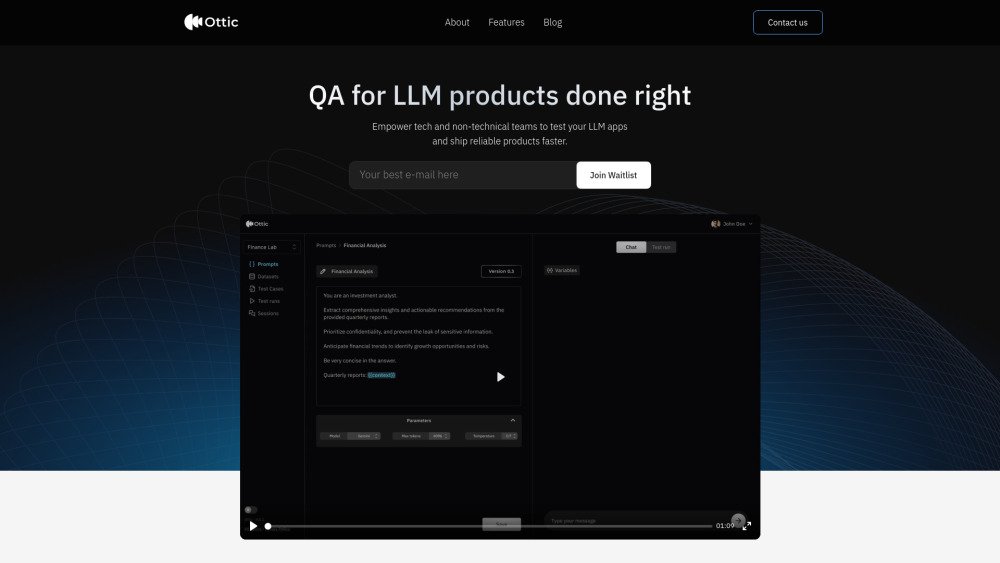
Ottic is a platform designed to evaluate LLM-powered applications, enabling both technical and non-technical teams to test their LLM apps and ship reliable products faster. It offers features like visual prompt management, end-to-end test management, comprehensive LLM evaluation, and user behavior monitoring. Ottic aims to provide a 360-degree view of the QA process for LLM applications, ensuring quality and reducing time to market.
Ottic integrates with your existing QA and engineering tools, allowing you to visually manage prompts, build comprehensive test suites, execute tests via sampling, and monitor user behavior in real-time. You can connect Ottic with your preferred tools and access support through a dedicated Slack channel.
Ottic provides a platform for evaluating LLM-powered applications, enabling both technical and non-technical teams to test their apps and ship reliable products faster.
Ottic streamlines testing and evaluation processes, which can accelerate the LLM application development cycle by up to 45 days.
Ottic integrates directly with the tools your QA and engineering teams already use.
Free plan available.
Use these comparison pages to understand the trade-offs between the models most relevant to Ottic.
Compare Amazon Nova Pro and Amazon Nova Lite across pricing, context window, capabilities, benchmarks, and API access to choose the better fit for tool-augmented workflows versus tool-augmented workflows.
Compare Amazon Nova Lite and Amazon Nova Micro across pricing, context window, capabilities, benchmarks, and API access to choose the better fit for tool-augmented workflows versus tool-augmented workflows.
Compare Amazon Nova Lite and Mistral Medium 3 across pricing, context window, capabilities, benchmarks, and API access to choose the better fit for tool-augmented workflows versus tool-augmented workflows.
Compare Amazon Nova Lite and Mistral Small 3.1 (25.03) across pricing, context window, capabilities, benchmarks, and API access to choose the better fit for tool-augmented workflows versus cost-efficient scale.