
Free
$0Free plan available.
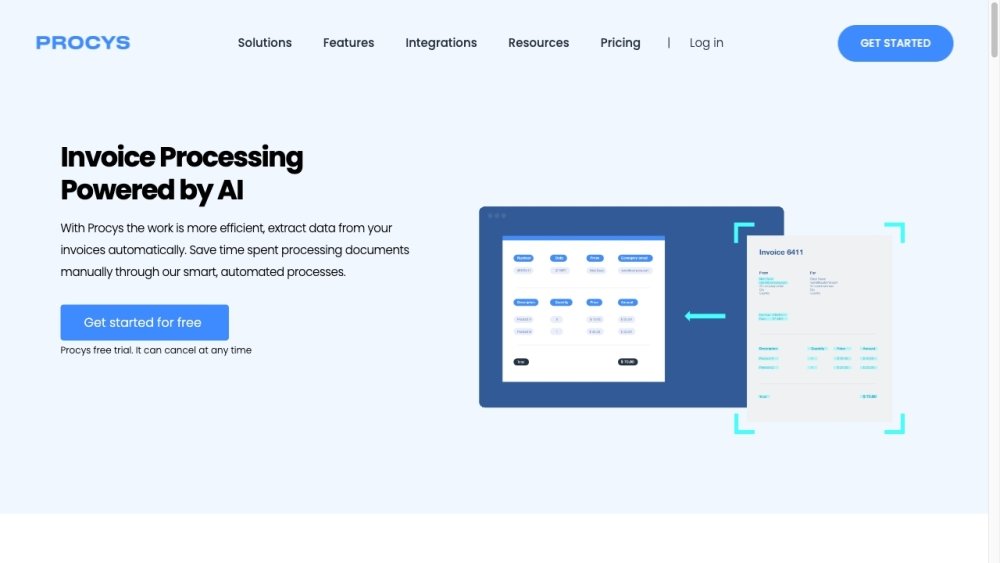
Procys is an automated document processing platform powered by AI. It helps businesses extract data from invoices, ID cards, receipts, and other key documents, automating workflows and saving time. Procys offers solutions for invoice OCR, ID card OCR, receipt OCR, and account payable automation, serving industries like travel agencies, restaurants, and tax agencies. The platform is ISO 27001-compliant and supports SOC 2 and GDPR standards, ensuring secure document automation.
Users can sign up for a free account, upload files in PDF, scan, or image formats, and allow the AI to automatically extract the required data. The platform supports integration with various ERP systems and provides API documentation for custom implementation.
The price per document is based on the assumption that each document includes a header and contains a maximum of 15 pages, ensuring a consistent billing structure.
For multi-page documents, the AI Auto-Split feature can automatically divide files for efficient processing. This ensures each page is handled correctly to maintain accuracy and consistency in data analysis.
Integration availability and costs vary by type. Some integrations may be free, while others may incur additional fees. Specific details are provided within the user interface, and any applicable costs are separate from your subscription or document processing fees.
Artificial Intelligence requires initial examples to improve its performance. Data annotation involves marking and categorizing elements within an image to help the AI learn. On the Procys platform, users can easily annotate data by drawing a box around the desired item and selecting its type from a dropdown menu.
Procys is ISO 27001 certified, reflecting our commitment to a robust information security management system. This certification ensures we meet international standards for protecting both our own and our clients' data, providing a secure and reliable service globally.
Free plan available.
Use these comparison pages to understand the trade-offs between the models most relevant to Procys.
Compare Gemini 1.0 Pro Deprecated and Gemini 2.0 Flash across pricing, context window, capabilities, benchmarks, and API access to choose the better fit for long-context workloads versus long-context workloads.
Compare Gemini 1.0 Pro Deprecated and Gemini 2.5 Flash across pricing, context window, capabilities, benchmarks, and API access to choose the better fit for long-context workloads versus long-context workloads.
Compare Gemini 2.0 Flash Lite and Gemini 2.0 Flash across pricing, context window, capabilities, benchmarks, and API access to choose the better fit for long-context workloads versus long-context workloads.
Compare Gemini 2.5 Flash and Gemini 2.0 Flash across pricing, context window, capabilities, benchmarks, and API access to choose the better fit for long-context workloads versus long-context workloads.

Similar AI tool in the AI Assistant category.
Similar AI tool in the AI Productivity Tools category.
Similar AI tool in the AI Marketing category.
Similar AI tool in the AI Writing Assistants category.
Similar AI tool in the AI Writing Assistants category.
Similar AI tool in the AI Writing Assistants category.
Similar AI tool in the AI Assistant category.
Similar AI tool in the AI Chatbot category.
Similar AI tool in the No-Code&Low-Code category.
Similar AI tool in the AI Productivity Tools category.
Similar AI tool in the AI Marketing category.
Similar AI tool in the AI Assistant category.