
Free
$0Free plan available.
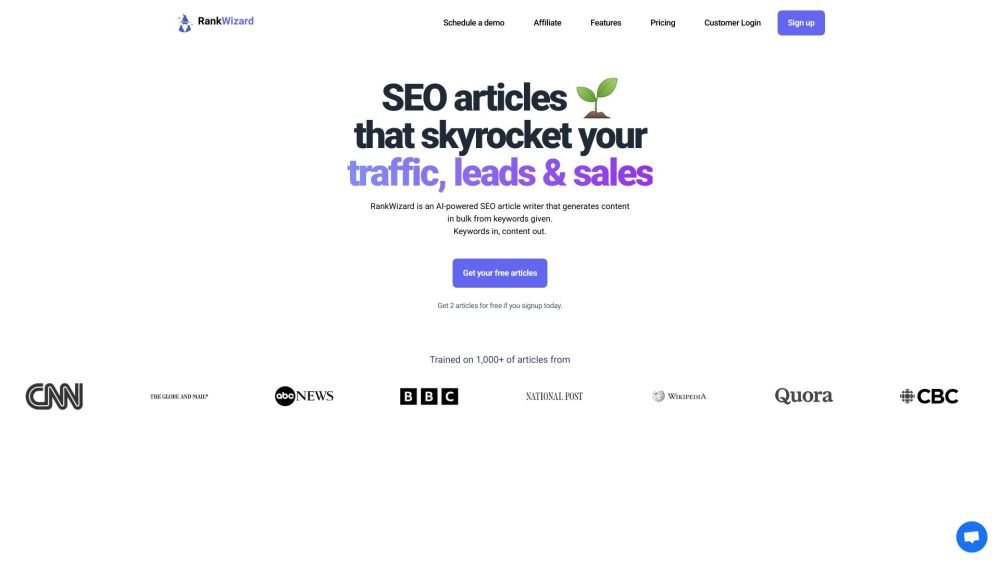
RankWizard is a programmatic SEO writer that generates content in bulk using AI. Every article is supported by AI-conducted research to ensure the information is accurate and current. The platform also includes contextual image generation via Midjourney AI and utilizes real-time data, SERP analysis, and GPT-4 to create content designed to rank.
RankWizard requires a list of keywords from you. Once provided, the tool analyzes search engine data to understand the topics. It then generates articles for you, which can be exported to your blog with a single click.
RankWizard is an AI writer designed to streamline the creation of articles, blog posts, and newsletters. Simply provide a list of keywords, and the tool will analyze search engine data to understand the topics before generating articles that you can export to your blog with one click.
While other tools may produce generic content, RankWizard provides a streamlined experience for creating high-quality, bulk articles by integrating real-time data, search engine analysis, and GPT-4.
No. Google does not penalize AI-generated content as long as it remains engaging for readers, which is the primary focus of RankWizard.
Yes. RankWizard generates unique, original content by utilizing multiple AI models.
You can export your content as an archive in Markdown, HTML, or CSV spreadsheet formats.
Yes, you can start using RankWizard for free. We offer a free plan with limited features, including 2 keywords per month.
Yes, you may cancel your subscription at any time, though we do not offer refunds.
Yes, if you require high-volume usage, please contact us at ceo@rankwizard.ai.
RankWizard offers monthly and annual subscription plans, as well as a pay-as-you-go option at $2.50 per keyword.
We provide support via live chat, email at ceo@rankwizard.ai, or through a scheduled call.
RankWizard currently supports 99 languages. If your preferred language is not listed on our platform, please reach out to us.
Free plan available.
Use these comparison pages to understand the trade-offs between the models most relevant to RankWizard.
Compare GPT 5.4 and GPT 5.4 Pro across pricing, context window, capabilities, benchmarks, and API access to choose the better fit for long-context workloads versus long-context workloads.
Compare GPT 5.5 and GPT 5.4 across pricing, context window, capabilities, benchmarks, and API access to choose the better fit for long-context workloads versus long-context workloads.
Compare GPT 5.5 and Claude 4.6 Opus across pricing, context window, capabilities, benchmarks, and API access to choose the better fit for long-context workloads versus long-context workloads.
Compare GPT 5.5 and Claude 4.6 Sonnet across pricing, context window, capabilities, benchmarks, and API access to choose the better fit for long-context workloads versus long-context workloads.

Similar AI tool in the AI Transcription category.
Similar AI tool in the AI Copilot category.
Similar AI tool in the AI Summarizer category.
Similar AI tool in the AI Assistant category.
Similar AI tool in the AI Productivity Tools category.
Similar AI tool in the AI Writing Assistants category.
Similar AI tool in the AI Image Generator category.
Similar AI tool in the AI Chatbot category.
Similar AI tool in the AI Writing Assistants category.
Similar AI tool in the AI Assistant category.
Similar AI tool in the AI Writing Assistants category.
Similar AI tool in the AI Assistant category.