
Free
$0Free plan available.
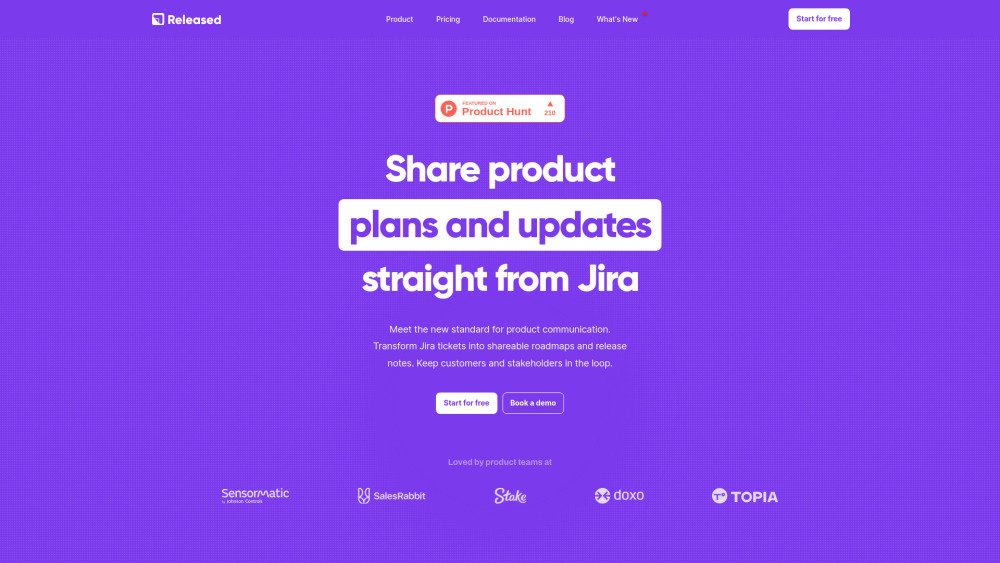
Released is a product communication platform designed to transform Jira tickets into shareable roadmaps and release notes. It helps product teams keep customers and stakeholders in the loop by creating a central hub for product communication. With Released, users can share Jira roadmaps, publish release notes, collect feedback, and create product portals with cross-project roadmaps from Jira. The platform offers features like tailored roadmaps, AI-powered release notes, and direct feedback collection, all seamlessly integrated with Atlassian user management and security practices.
Released connects to your Jira instance, allowing you to transform internal Jira Product Discovery roadmaps into dynamic portals. You can customize views, share roadmaps and release notes, and collect feedback. Users can authenticate via Atlassian ID, Google, or email verification to access restricted portals. The portal can be hosted on a custom domain or embedded directly within your website or app.
No, users can access restricted portals by authenticating via Atlassian ID, Google, or email verification without needing a Jira license.
Yes, Released is SOC 2 Type 2 certified and integrates with Atlassian user management and security protocols. All data is encrypted both in transit and at rest.
Yes, you can customize the portal's appearance by adding your company logo and brand colors.
Yes, you can host your portal on a custom domain or embed it directly into your website or application.
Released features an AI copywriter that generates release notes from Jira tickets, allowing you to create content up to 10x faster. You can also adjust the AI settings to match your brand's tone of voice.
Free plan available.
Use these comparison pages to understand the trade-offs between the models most relevant to Released.
Compare Gemini 1.0 Pro Deprecated and Gemini 2.0 Flash across pricing, context window, capabilities, benchmarks, and API access to choose the better fit for long-context workloads versus long-context workloads.
Compare Gemini 1.0 Pro Deprecated and Gemini 2.5 Flash across pricing, context window, capabilities, benchmarks, and API access to choose the better fit for long-context workloads versus long-context workloads.
Compare Gemini 2.0 Flash Lite and Gemini 2.0 Flash across pricing, context window, capabilities, benchmarks, and API access to choose the better fit for long-context workloads versus long-context workloads.
Compare Gemini 2.5 Flash and Gemini 2.0 Flash across pricing, context window, capabilities, benchmarks, and API access to choose the better fit for long-context workloads versus long-context workloads.

Similar AI tool in the AI Assistant category.
Similar AI tool in the AI Productivity Tools category.
Similar AI tool in the AI Chatbot category.
Similar AI tool in the AI Writing Assistants category.
Similar AI tool in the AI Assistant category.
Similar AI tool in the AI Image Generator category.
Similar AI tool in the AI Writing Assistants category.
Similar AI tool in the AI Writing Assistants category.
Similar AI tool in the AI Assistant category.
Similar AI tool in the AI Chatbot category.
Similar AI tool in the AI Image Generator category.
Similar AI tool in the AI Image Generator category.