
Free
$0Free plan available.
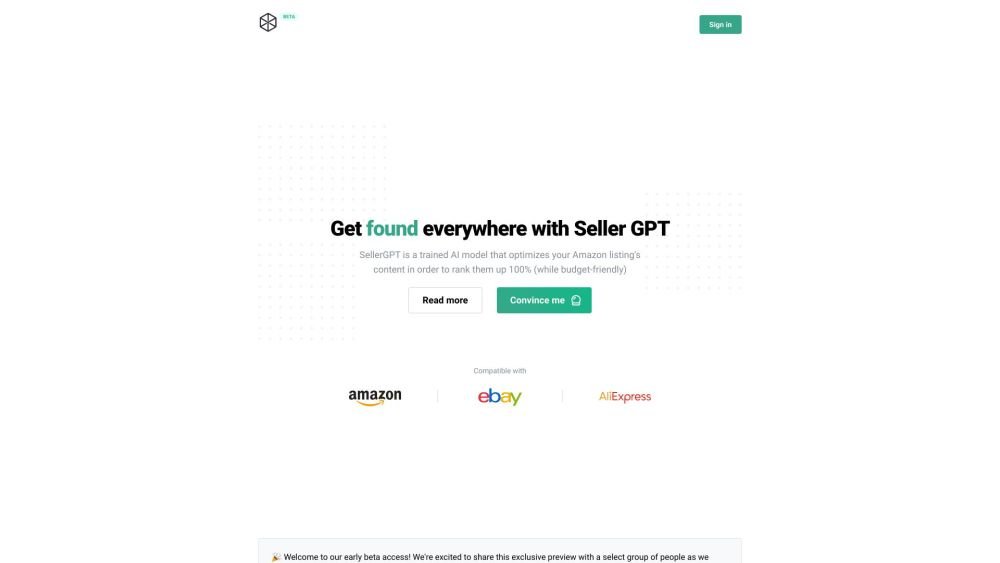
A specialized AI-driven platform designed to assist Amazon sellers in creating compelling listing content, built with a focus on how Amazon's ranking algorithms function.
Provide your product details, and the AI will generate optimized listing content aligned with Amazon's ranking algorithms.
The AI utilizes an understanding of Amazon's ranking factors to incorporate relevant keywords, persuasive descriptions, and optimized formatting to enhance product visibility.
Free plan available.
Use these comparison pages to understand the trade-offs between the models most relevant to Amazon Listing AI.
Compare GPT 5.4 and GPT 5.4 Pro across pricing, context window, capabilities, benchmarks, and API access to choose the better fit for long-context workloads versus long-context workloads.
Compare GPT 5.5 and GPT 5.4 across pricing, context window, capabilities, benchmarks, and API access to choose the better fit for long-context workloads versus long-context workloads.
Compare GPT 5.5 and Claude 4.6 Opus across pricing, context window, capabilities, benchmarks, and API access to choose the better fit for long-context workloads versus long-context workloads.
Compare GPT 5.5 and Claude 4.6 Sonnet across pricing, context window, capabilities, benchmarks, and API access to choose the better fit for long-context workloads versus long-context workloads.

Similar AI tool in the AI Assistant category.
Similar AI tool in the AI Assistant category.
Similar AI tool in the AI Chatbot category.
Similar AI tool in the AI Writing Assistants category.
Similar AI tool in the AI Image Generator category.
Similar AI tool in the AI Image Generator category.
Similar AI tool in the AI Writing Assistants category.
Similar AI tool in the AI Assistant category.
Similar AI tool in the AI Chatbot category.
Similar AI tool in the AI Chatbot category.
Similar AI tool in the AI Image Generator category.
Similar AI tool in the AI Writing Assistants category.