
Free
$0Free plan available.
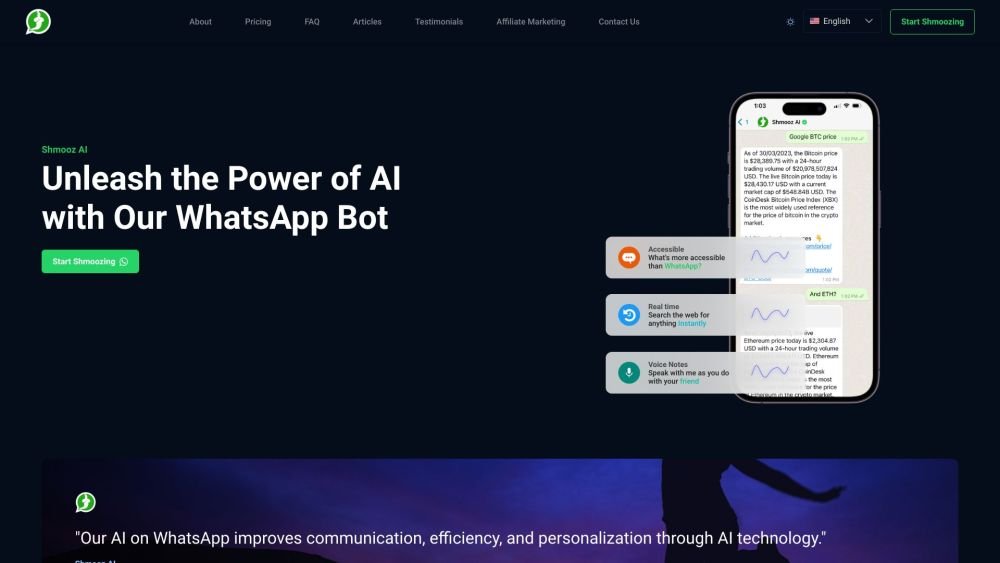
Shmooz AI is an AI assistant designed to be easy and accessible, available on WhatsApp and the web. It offers features like image generation, real-time data access via Google, article summarization, and file interaction. It aims to provide the best AI models for users who want to leverage AI on WhatsApp or the web.
Access Shmooz AI via WhatsApp or the web. To use specific features, start your messages with 'image' to generate visuals, 'Google' to retrieve real-time data, or send a link to receive an article summary. You can also upload and interact with files.
The chatbot is an artificial intelligence program designed to interact with users through text-based conversation. It utilizes natural language processing and machine learning to understand and respond to queries in real-time.
Shmooz offers several features to assist with daily conversations. It is available 24/7 and is context-aware, allowing it to understand and respond to the context of your messages. Additionally, you can generate images by starting a message with 'image' or perform Google searches by starting a message with 'google'.
Yes, Shmooz can generate images based on your input. By starting your message with the word 'image,' the AI will create an image based on your provided context.
Yes, by starting a message with the word 'Google,' Shmooz can perform a search and provide you with relevant results.
Yes, Shmooz can summarize shared URLs by extracting key information from the page to provide a concise summary.
Yes, Shmooz can process voice notes. It transcribes the audio and generates a text-based response based on the content of the note.
You can manage your subscription by navigating to the pricing section on the website and selecting the 'Manage Subscription' button. This allows you to view subscription details, update payment information, or cancel your plan.
Yes, you can cancel your subscription at any time via the 'Manage Subscription' button in the pricing section. While refunds are not provided for cancellations, you will retain access to subscription features until the end of your current billing cycle.
Free plan available.
Use these comparison pages to understand the trade-offs between the models most relevant to Shmooz AI.
Compare Gemini 1.0 Pro Deprecated and Gemini 2.0 Flash across pricing, context window, capabilities, benchmarks, and API access to choose the better fit for long-context workloads versus long-context workloads.
Compare Gemini 2.0 Flash Lite and Gemini 2.0 Flash across pricing, context window, capabilities, benchmarks, and API access to choose the better fit for long-context workloads versus long-context workloads.
Compare Gemini 1.0 Pro Deprecated and Gemini 1.5 Flash Deprecated across pricing, context window, capabilities, benchmarks, and API access to choose the better fit for long-context workloads versus general-purpose AI workloads.
Compare Gemini 1.0 Pro Deprecated and Gemini 1.5 Flash Vision Deprecated across pricing, context window, capabilities, benchmarks, and API access to choose the better fit for long-context workloads versus general-purpose AI workloads.

Similar AI tool in the AI Assistant category.
Similar AI tool in the AI Assistant category.
Similar AI tool in the AI Chatbot category.
Similar AI tool in the AI Assistant category.
Similar AI tool in the AI Image Generator category.
Similar AI tool in the AI Assistant category.
Similar AI tool in the AI Chatbot category.
Similar AI tool in the AI Chatbot category.
Similar AI tool in the AI Image Generator category.
Similar AI tool in the AI Image Generator category.
Similar AI tool in the AI Assistant category.
Similar AI tool in the AI Assistant category.