
Free
$0Free plan available.
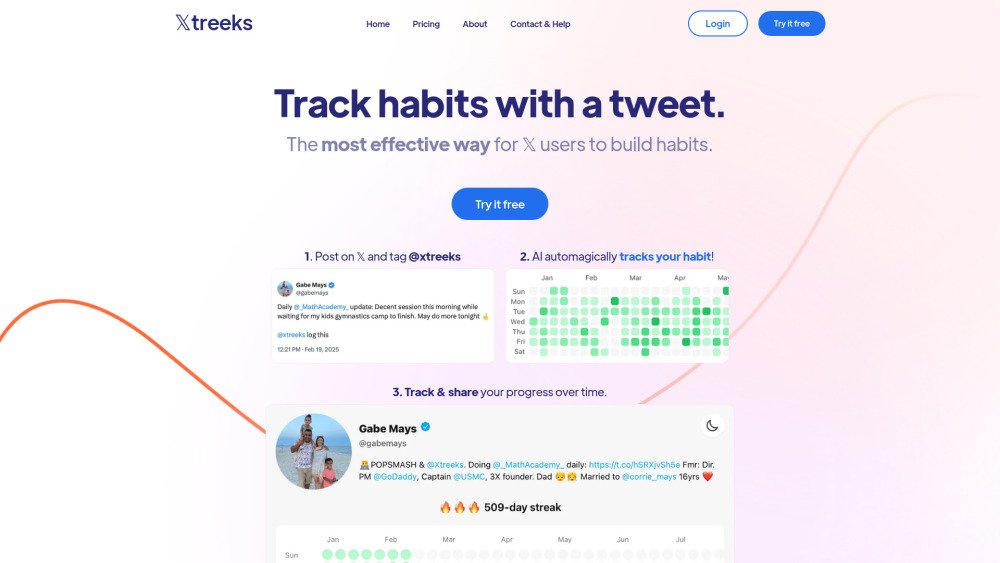
HabitGraph is a habit tracker for X users that natively integrates with your account to log habits via tweets. It enables users to maintain current habits and establish new ones by recording progress in posts. The app utilizes AI to automatically track your data and display your progress in a clean, GitHub-style grid. It offers both free and paid plans with additional features.
Log in with your X account, post a tweet tagging @HabitGraph to record your habit, and the AI will track your progress. You can then monitor and share your consistency over time.
HabitGraph is a habit tracking application that allows users to log their habits through X posts.
Sign up by logging into HabitGraph with your X account. Tweet a habit update while mentioning @HabitGraph to log it, and our AI will record the activity in your habit graph.
Yes, users on a paid plan can perform habit check-ins directly within the HabitGraph dashboard.
Yes, choosing an annual plan provides you with two months free.
Yes, if you are unsatisfied with HabitGraph for any reason, contact us within 30 days for a refund. Our paid plans also include a free trial.
We are happy to help. You can reach out to us at help@habitgraph.ai or visit our help site.
Free plan available.
Use these comparison pages to understand the trade-offs between the models most relevant to HabitGraph.
Compare Amazon Nova Pro and Amazon Nova Lite across pricing, context window, capabilities, benchmarks, and API access to choose the better fit for tool-augmented workflows versus tool-augmented workflows.
Compare Amazon Nova Lite and Amazon Nova Micro across pricing, context window, capabilities, benchmarks, and API access to choose the better fit for tool-augmented workflows versus tool-augmented workflows.
Compare Amazon Nova Lite and Mistral Medium 3 across pricing, context window, capabilities, benchmarks, and API access to choose the better fit for tool-augmented workflows versus tool-augmented workflows.
Compare Amazon Nova Lite and Mistral Small 3.1 (25.03) across pricing, context window, capabilities, benchmarks, and API access to choose the better fit for tool-augmented workflows versus cost-efficient scale.