
Free
$0Free plan available.
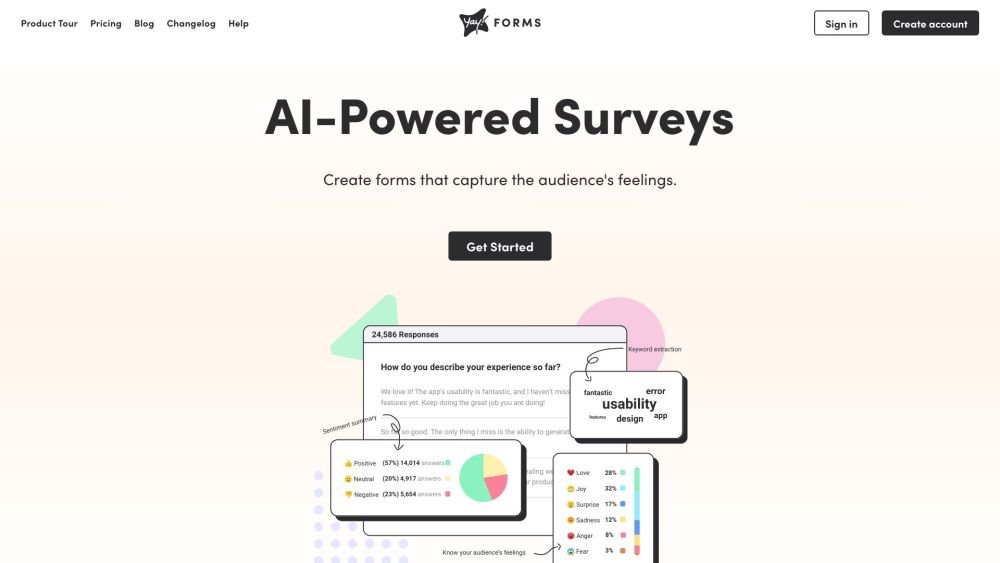
Yay! Forms is a form builder that uses artificial intelligence to generate insights from customer data. It allows users to create personalized surveys, quizzes, and forms quickly, turning data into valuable insights automatically to simplify decision-making. It offers a wide range of applications for marketing, product, customer success, HR, research, and agency teams.
Build your forms using the Yay! Forms editor, customize them with logic branches and branding, embed them on your website or share them directly, and utilize the AI to analyze responses for actionable insights.
Yes, you can try the platform for free for 7 days. If you choose not to continue, you can cancel your account at any time.
You can cancel your subscription independently. Log in to your account, click on your name at the top, and select "Billing" to find options for canceling or switching plans.
You will receive an email notification as you approach your limit. To keep your forms active, you can either upgrade to a plan with a higher limit or enable the “additional responses” add-on. If you enable the add-on, you will be charged an additional fee based on the number of extra responses received, as detailed in our pricing table.
Yes, you can enable the “additional responses” add-on to continue collecting data beyond your plan’s limit. You will be charged based on the volume of extra responses.
Yes, you can add unlimited teammates and organize them into specific workspaces. This ensures users only have access to the forms relevant to their department, such as separating marketing and HR workspaces.
Yes, please contact our support team, and we will assist you with migrating your forms.
Free plan available.
Use these comparison pages to understand the trade-offs between the models most relevant to Yay! Forms.
Compare Gemini 1.0 Pro Deprecated and Gemini 2.0 Flash across pricing, context window, capabilities, benchmarks, and API access to choose the better fit for long-context workloads versus long-context workloads.
Compare Gemini 1.0 Pro Deprecated and Gemini 2.5 Flash across pricing, context window, capabilities, benchmarks, and API access to choose the better fit for long-context workloads versus long-context workloads.
Compare Gemini 2.0 Flash Lite and Gemini 2.0 Flash across pricing, context window, capabilities, benchmarks, and API access to choose the better fit for long-context workloads versus long-context workloads.
Compare Gemini 2.5 Flash and Gemini 2.0 Flash across pricing, context window, capabilities, benchmarks, and API access to choose the better fit for long-context workloads versus long-context workloads.

Similar AI tool in the AI Assistant category.
Similar AI tool in the AI Assistant category.
Similar AI tool in the AI Chatbot category.
Similar AI tool in the AI Marketing category.
Similar AI tool in the AI Assistant category.
Similar AI tool in the AI Chatbot category.
Similar AI tool in the AI Chatbot category.
Similar AI tool in the AI Marketing category.
Similar AI tool in the Large Language Models (LLMs) category.
Similar AI tool in the AI Marketing category.
Similar AI tool in the AI Marketing category.
Similar AI tool in the AI Assistant category.