
Free
$0Free plan available.
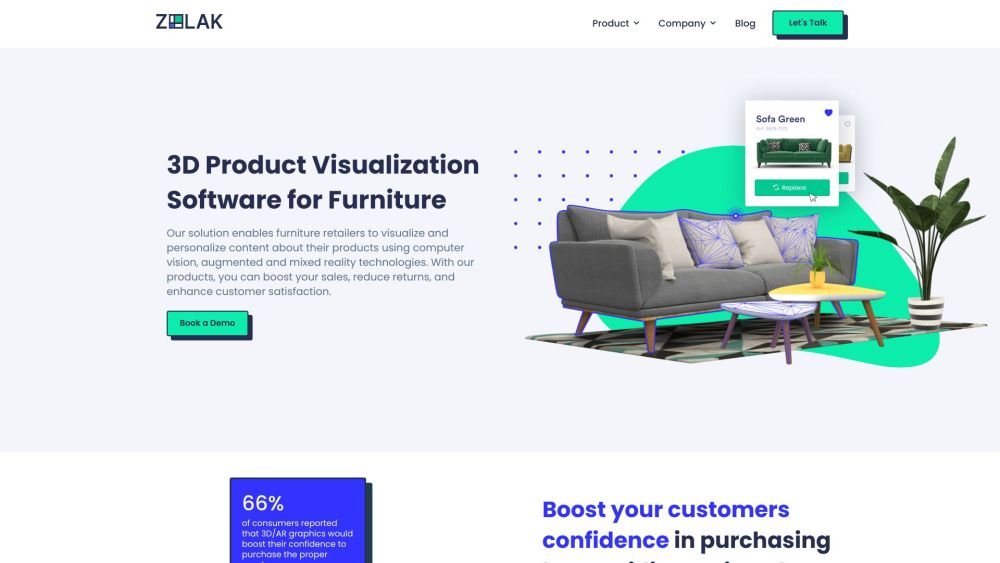
Zolak offers innovative 3D product visualization software for furniture retailers. It enhances the customer shopping experience with computer vision and AI, providing interactive 3D showrooms on websites. The platform aims to boost sales, increase conversion rates, and engage customers with immersive product visualization and interior design ideas.
Furniture retailers use Zolak to integrate interactive 3D showrooms into their websites. Customers can then use augmented reality and personalized visualization tools to view furniture within their own living spaces.
A 3D product visualizer is a tool that allows customers to view products in three dimensions, providing a more realistic preview of the item.
AR 3D product visualization uses augmented reality technology to create realistic, interactive product displays. It allows users to view and interact with products in real-world environments using a smartphone or tablet.
Product visualization for ecommerce involves using computer-generated imagery (CGI) and advanced technologies—such as 3D modeling, computer vision, and virtual or augmented reality—to create realistic product representations for online stores.
Product visualizations for ecommerce help customers better understand the products they are considering. This can lead to reduced returns, higher customer satisfaction, and increased sales.
Ecommerce product visuals are created using 3D modeling, computer vision, and virtual or augmented reality to generate realistic and interactive product representations for display on websites.
3D product visualization allows customers to view products in a realistic and personalized way. Unlike a static photo catalog, a visualizer lets consumers interact with the product, customize it, and view it from multiple angles. Additionally, 3D visualization can save companies time and money by reducing the need for expensive photoshoots and physical prototypes.
Free plan available.
Use these comparison pages to understand the trade-offs between the models most relevant to Zolak.
Compare Amazon Nova Pro and Amazon Nova Lite across pricing, context window, capabilities, benchmarks, and API access to choose the better fit for tool-augmented workflows versus tool-augmented workflows.
Compare Amazon Nova Lite and Amazon Nova Micro across pricing, context window, capabilities, benchmarks, and API access to choose the better fit for tool-augmented workflows versus tool-augmented workflows.
Compare Amazon Nova Lite and Mistral Medium 3 across pricing, context window, capabilities, benchmarks, and API access to choose the better fit for tool-augmented workflows versus tool-augmented workflows.
Compare Amazon Nova Lite and Mistral Small 3.1 (25.03) across pricing, context window, capabilities, benchmarks, and API access to choose the better fit for tool-augmented workflows versus cost-efficient scale.

Similar AI tool in the AI Image Generator category.
Similar AI tool in the AI Assistant category.
Similar AI tool in the AI Image Generator category.
Similar AI tool in the AI Chatbot category.
Similar AI tool in the AI Writing Assistants category.
Similar AI tool in the AI Image Generator category.
Similar AI tool in the AI Writing Assistants category.
Similar AI tool in the AI Writing Assistants category.
Similar AI tool in the AI Assistant category.
Similar AI tool in the AI Image Generator category.
Similar AI tool in the AI Chatbot category.
Similar AI tool in the AI Video Generator category.